WAN CHAI HERITAGE TRAIL (approx 3km)
Wan Chai is one of Hong Kong's earliest settlements and has an interesting heritage, possessing many fine historic buildings from different periods. The district was once the home of high-class residences for rich Europeans and foreign merchants and shipyards were built along the shores of Wan Chai Bay before reclamation eventually saw the transition from small fishing village to modern urban metropolis. During 2007 in order to address increasing public concern over conservation the Old Wan Chai Revitalisation Initiatives Steering Committee was formed to study the cultural heritage of Wan Chai and on 27th September 2009 the Wan Chai Heritage Trail was launched. Wan Chai District Council, The Development Bureau, Urban Renewal Authority, MTR Corp, St James' Settlement and Wan Chai District Office are all partners in the revitalisation project. The Urban Renewal Authority is still negotiating with other building owners in Wan Chai with a view to renovation of other historic properties and the Wan Chai model will be used as the basis for other similar conservation projects in other districts of Hong Kong.
The trail starts at Mallory Street and ends at Wing Fung Street near Admiralty Station and takes in buildings of historical, architectural and cultural interest. Touch-screen computers have been installed at various points along the route to allow visitors to view details and obtain information about the history of the buildings.
TRAIL DESCRIPTIVE LEAFLET AND MAP
A descriptive leaflet and map detailing the trail is usually available at Hong Kong Heritage Discovery Centre in Kowloon Park (closed Thursdays). The leaflet (pdf format) can also be downloaded here;
http://www.ura.org.hk/media/950737/eng_final.pdf
BUILDINGS ALONG THE TRAIL;
GREEN HOUSE (1-11 Mallory Street & 4-22 Burrows Street) – early 20th century cluster of buildings with narrow reinforced concrete balcony. French windows, cast iron pillar and iron balustrade reflect Western influence. Once housed the famous Yau Chai Kee Restaurant and Hong Kong Sinfonietta. The "Green House" comprises ten historic four-storey tenements at Mallory Street and Burrows Street and has been preserved and revitalised in a HK$200 million project undertaken between 2010 and 2013 and become home to Comix Home Base, which has been established as a platform for exchange and interaction of the comic industry both locally and overseas. The tenements combine both Chinese and Western architectural styles. Wan Chai was one of the areas populated by Western settlers following the British colonisation of Hong Kong in 1841, and many buildings in the locality carried with them a strong European flavour. The ten tenement houses at Mallory Street and Burrows Street are all four-storey high and built with cantilevered balconies supported by brackets and posts on the upper floors. Floors, ceilings and staircases are made of China fir. Other architectural features include pitched Chinese tiled roofs and French doors at 1-7 Mallory Street. Interior timber staircases with timber handrails enclosed by timber planking, as well as ornamental iron balustrades at the balconies, and cement floor tiles with different patterns are distinguishing traits of 1-7 Mallory Street. Among these, the iron balcony balustrades are one of the most distinctive features of these buildings' exteriors. Pitched Chinese pan and roll tiled roofs originate from traditional Chinese architecture, while designs such as French doors are elements from the West. The tenement houses at Mallory Street and Burrows Street originally in dark grey were not named. Four Mallory Street tenement houses (Nos. 3, 5, 7 & 9) and two Burrows Street tenement houses (Nos. 6 & 8) were taken over by the government, and were subsequently painted green, widely known as the "Green House" thereafter. In the 1930s, the timber floor and pitched roof of Nos. 9 & 11 Mallory Street had been converted into reinforced concrete construction with a flat roof. The revitalised buildings also include a 300-square metre public open space for the enjoyment of the community. There are studios for comic and animation artists as well as a resource centre library that collects print and digital comic books and magazines. Other features included exhibition rooms, educational workshops, retail space for selling comics and related merchandise as well as food and beverages facilities/outlets. Below-market rents for tenants have enabled some of Hong Kong’s oldest restaurants including Western-style Queen’s Café and Ho Wah cha chaan teng to open up in the tenements.
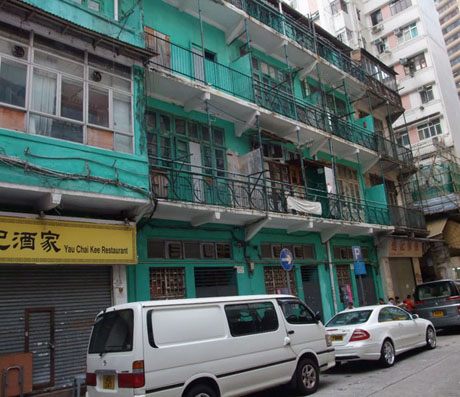
The Green House, which has been subject of a HK$200 million preservation and revitalisation project and now houses Comix Home Base
HONG KONG TUBERCULOSIS CHEST AND HEART DISEASE ASSOCIATION - (266 Queens Road East) - built in "Bauhaus" architectural style in 1950. Former Royal Navy Hospital, now part of Ruttonjee Hospital.
WAN CHAI MARKET (Queens Road East) – rebuilt in 1937 with “Streamline Moderne” architectural style and curved façade influenced by curvilinear shapes of the early 20th century.
BLUE HOUSE (72-74A Stone Nullah Lane) Closed for renovation until early 2017– built early 20th century, the original site of Hua Tuo Temple and Hospital. Surplus blue paint from the government was used during renovation in 1920’s, hence the name “Blue House”. Number 74 now houses the Hong Kong House of Stories (previously Wan Chai Livelihood Place), a community project sponsored by Hong Kong Bank Foundation, which organises exhibitions on local culture and trains local Wan Chai residents as cultural tour guides to lead community tours in Wan Chai and Central and arranges "community classrooms" where traditional craftsmen, young artists, organic farmers and housewives act as instructors to pass on the culture and craft skills of the old community. Hong Kong House of Stories is open 11am to 6pm daily, except Wednesdays and public holidays, and admission is free. A revitalization project "Viva Blue House" was launched in 2014 was expected to cost over HK$56 million. The project was completed in 2017 and has seen the buildings renovated, a residential scheme for new and existing tenants, culture and educational programmes, heritage tours, a dessert shop and vegetarian restaurant. Cocklofts have been preserved to display past living conditions.
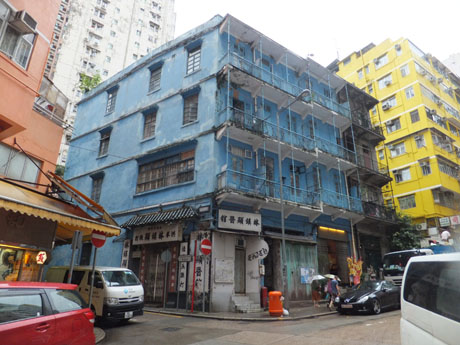
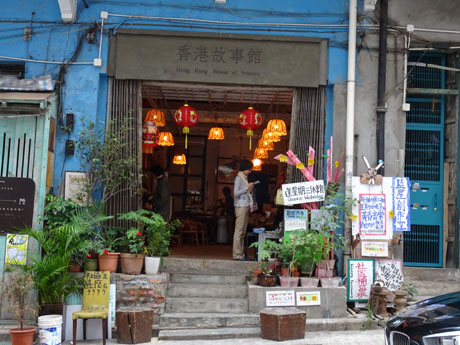
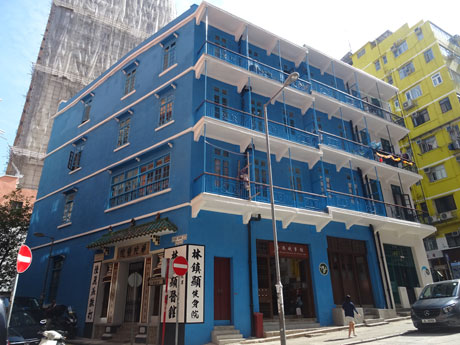
The Blue House, seen in December 2017, following the "Viva Blue House" revitalization project
Blue House, a Grade 1 Historic Building on Stone Nullah Lane, currently houses Hong Kong House of Stories, a community project which organises exhibitions, community classes and trains locals as cultural tour guides. It is open daily except Wednesdays and public holidays. Blue House was subject of a revitalization project which commenced in 2014 and was completed in 2017
YELLOW HOUSE (2-4 Hing Wan Street) – Western style façade with “pediment resembling” moulding above the shop front, iron grilles and arched windows. The Yellow House is to be renovated under the same revitalisation project as the Blue House (see above).
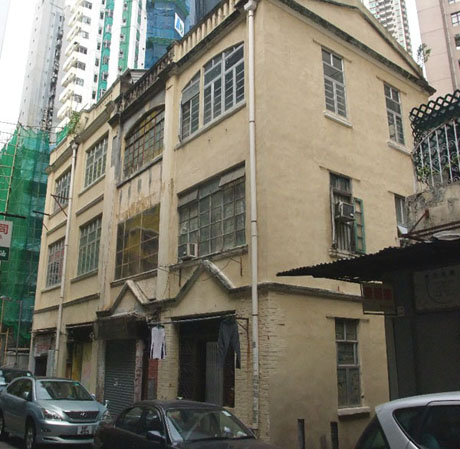
Yellow House on Hing Wan Street with Western style facade. The narrowness of the street means features such as balconies normally found in shophouses cannot be accommodated
PAK TAI TEMPLE (Stone Nullah Lane) – built 1862 in Chinese courtyard style and renovated 2005. Decorations include Chinese stone and wood carvings. The “Shiwan” pottery roof exhibits Cantonese opera stories.
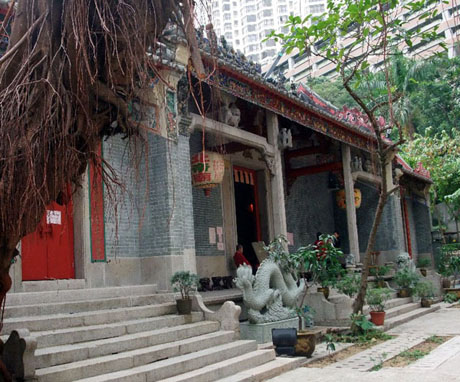
Pak Tai Temple. The "Shiwan" pottery roof exhibits Cantonese opera stories, typical of "Lingnan" architecture
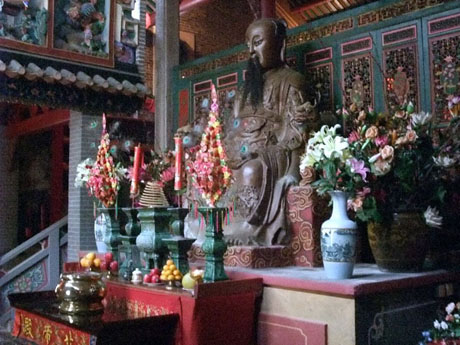
The temple contains various gods and statues with high aesthetic values and has Chinese stone and wood carvings and elaborate mouldings
CROSS STREET/TAI YUEN STREET OPEN MARKET – typical of street markets personified in films such as “The World of Suzie Wong”. Tai Yuen Street is also famous for its toy shops.
FORMER WAN CHAI POST OFFICE (Queens Road East) – built 1915 and now an environmental resource centre. The letter pigeon holes are still preserved.
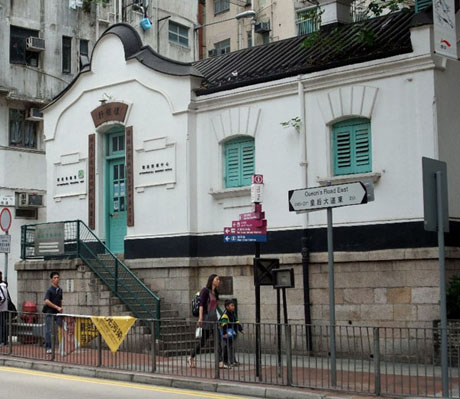
Former Wan Chai Post Office
186-190 QUEENS ROAD EAST - Guangzhou Verandah Type Shophouse built 1930’s with reinforced concrete. Tai Shing Goldsmith and Chi Sang Goldsmith operated there until 2005.
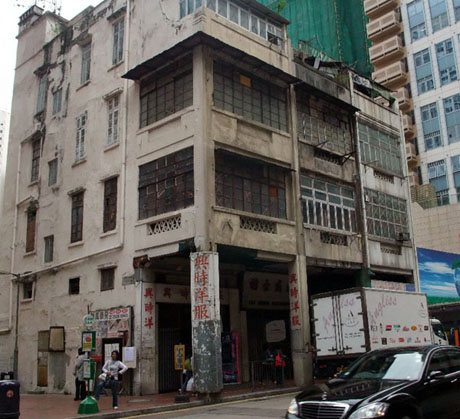
186-190 Queens Road East, a "Guangzhou Verandah Type" shophouse
HUNG SHING TEMPLE (Queens Road East) – Built mid-19th century against a boulder protruding inside which is used as a small altar table. “Shiwan” ceramic pottery decorations adorn the roof. Adjacent is Kwun Yin Temple built about 1910.
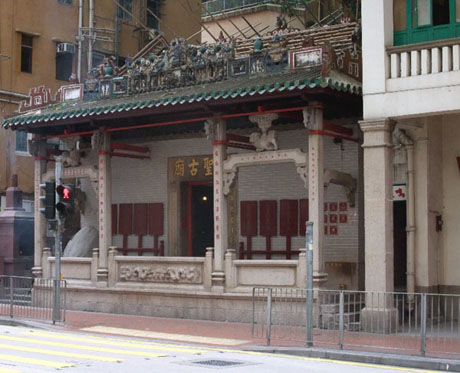
Hung Shing Temple, with "Shiwan" ceramic pottery roof decorations
60A-66 JOHNSTON ROAD – Guangzhou Verandah Type Shophouse now known as “The Pawn” and splendidly restored to its original outlook. Built early 20th century with deep verandah in response to the tropical climate. Now houses restaurants.
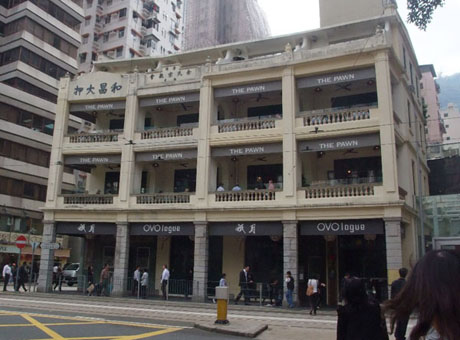
60A-66 Johnston Road, restored and now "The Pawn" accommodating restaurants
18 SHIP STREET – built early 20th century with Western style decorations and plastered column motifs. The Chinese shop sign is still preserved. Now the “Private Kitchen” Restaurant.
NAM KOU TERRACE (Ship Street) – built 1918 by the tycoon To Chun-man. It has been vacant since his death but was purchased by Hopewell Holdings in the 1970’s for redevelopment. Built in both Chinese and Western architectural styles and also known as the “Red House” owing to the colour of its bricks. Reaching Nam Kou Terrace involves climbing a long steep set of steps.
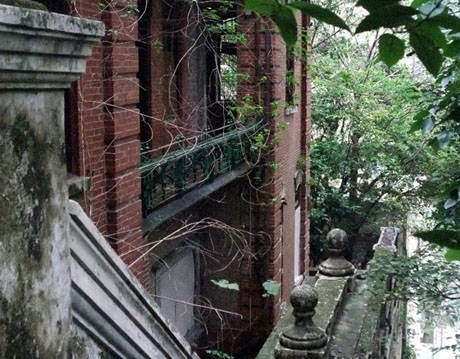
Nam Kou Terrace
GRESSON STREET OPEN MARKET – established in the 1950’s along a short street selling both wet and dry goods.
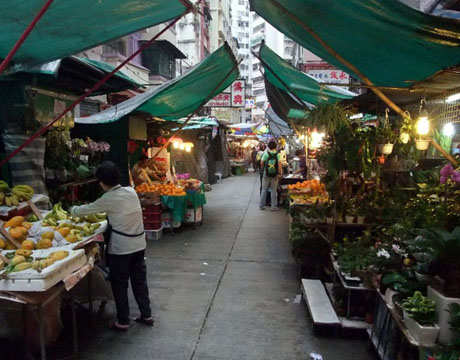
Gresson Street Open Market
STAR STREET PRECINCT (INCLUDING 31 WING FUNG STREET) – St Francis Church and a hospital were built in the area in 1845 and the sloping St Francis Yard became a gathering place for catholics. In 1890 Hong Kong’s first power plant was built on the slope above St Francis Lane. 31 Wing Fung Street is an “art deco” style residential building.
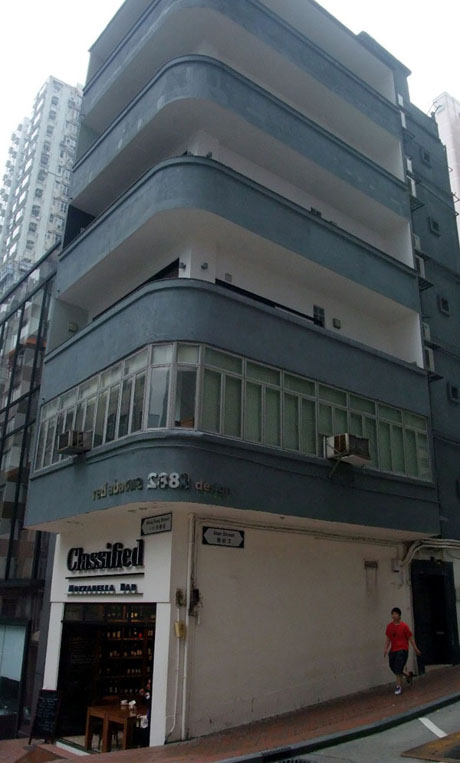
"Art Deco" style building at 31 Wing Fung Street at the junction with Star Street
TRAIL WEBSITE
http://www.ura.org.hk/en/projects/heritage-preservation-and-revitalisation/wan-chai/wan%20chai%20heritage%20trail.aspx
GETTING THERE
The nearest MTR station to the start of the trail at Mallory Street is Wan Chai Station. From Exit A3 follow the tram route east along Johnston Road then follow Wan Chai Road from its junction with Johnston road for a short distance to Mallory Street on the left.
Trams operating along the main route on Hong Kong Island through Wan Chai travel along Johnston Road passing close to both the start and finish points of the trail.
Queens Road East, Johnston Road and Hennessy Road are served by numerous bus routes.
The finish of the trail is close to Exit G of Admiralty MTR Station at Three Pacific Place.
OTHER HERITAGE TRAILS