ABOUT HONG KONG
Hong Kong has been a Special Administrative Region of the People’s Republic of China (PRC) since 1st July 1997. Under the Sino-British Joint Declaration between the governments of the United Kingdom of Great Britain and Northern Ireland (UK) and the PRC which transferred sovereignty to the PRC, Hong Kong enjoys a high degree of autonomy under Basic Law for a period of 50 years other than in areas of defence and foreign affairs.
Hong Kong is a modern, vibrant and cosmopolitan city and one of the most important international finance and business centres in the world, being a “gateway” between Mainland China and the rest of the world.
The meaning of Hong Kong is “Fragrant Harbour”.
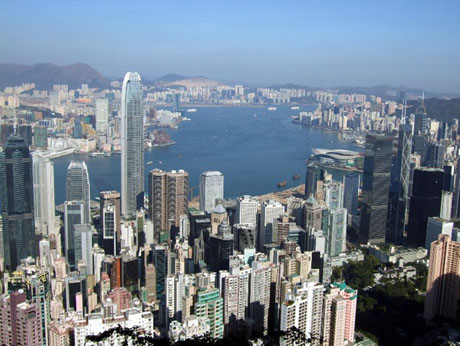
Victoria Harbour, Hong Kong Island and Kowloon from Victoria Peak, the highest point on Hong Kong Island but only Hong Kong's 31st highest peak
GEOGRAPHY:
Hong Kong is situated at the mouth of the Pearl River Delta (Zhu Jiang) on the southeastern coast of China, adjoining Guangdong Province. It lies about 130km to the southeast of Guangzhou, 1200km southwest of Shanghai, 1100km northwest of Manila, 2400km north of Singapore and 2800km southwest of Tokyo.
It consists of Hong Kong Island, the Kowloon Peninsula, the New Territories and 262 outlying islands.
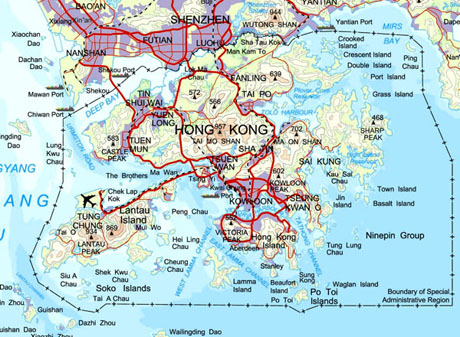
Total Area of Hong Kong Special Administrative Region (sq km):
Land Area* 1113.76
Sea Area** 1641.21
Total Area 2754.97
* Land area is the total of all land formed by the coastline which is a combination of sea wall, pier, breakwater, estuary, nullah outlets, rocky shoreline, the reclamation limits and High Water Mark (defined as being 2.3 metres above the Hong Kong Principal Datum). Rivers, reservoirs and ponds are included but the mangrove and swamp at seashore, mud flat, submerged rock and bridges over the sea are not included as land area.
** Sea area is the difference between the total area of the administrative division of the Hong Kong Special Administrative Region and its land area.
Land area by boundary (sq km);
Hong Kong Island 80.72
Kowloon 46.94
New Territories 985.94
Sea area 1640.40 sq km
Area of Hong Kong's major islands (sq km);
1. Lantau Island
148.40
2. Hong Kong Island
78.64
3. Chek Lap Kok 21.08
4. Lamma Island
13.85
5. Tsing Yi 10.69
6. Kau Sai Chau 6.70
7. Po Toi 3.69
8. Cheung Chau 2.44
9. Tung Lung Chau 2.42
10. Kat O (Crooked Island) 2.35
11. Wong Wan Chau (Double Island)
2.13
12. Hei Ling Chau 1.93
13. Tap Mun (Grass Island)
1.69
14. Shek Kwu Chau 1.32
15. Ap Lei Chau 1.30
16. Tai A Chau 1.20
17. Ping Chau 1.16
18. Sharp Island
(Kiu Tsui Chau) 1.00
19. Ma Wan 0.97
19. Peng Chau 0.97
21. Lung Kwu Chau 0.37
22. Green Island
0.12
23. Ap Chau 0.04
Source: Survey and Mapping Office, Lands Department, The Government of the Hong Kong Special Administrative Region
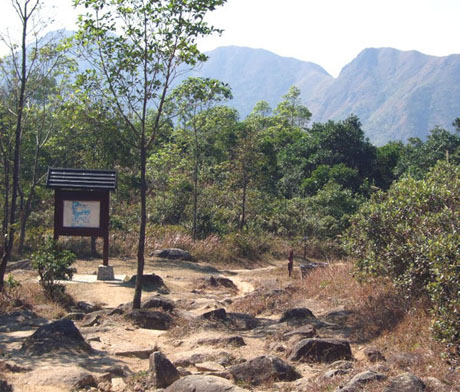
Less than 25% of Hong Kong's land area is built-up. Hong Kong has some outstanding, easily accessible country parks and rural scenery. Above is the MacLehose Trail, a popular 100km hiking trail, seen here near Shek Lung Tsai in the Sai Kung Country Park
CLIMATE:
Hong Kong has a sub-tropical and monsoonal climate with cool dry winters and hot wet summers. Between May and November the region is occasionally affected by tropical cyclones.
Average mean air temperature is approx 23C and ranges from about 15C to 25C during November to February, 18C to 27C in March/April, 25C to 35C in May to August and 25C to 30C in September/October.
Average annual sunshine 1850 hours approx. ranging from about 3.5 hours a day during February and March to 6.5 to 7 hours a day during July to October.
Humidity is at its highest during March to September (about 85%).
Average annual rainfall approx 2300mm. About 80% of rain falls between May and September, with the wettest months usually June and September with up to 450mm rain. The driest months are usually November, December and January with average monthly rainfall of about 30 to 40mm.
For more information see Hong Kong Observatory website;
http://www.hko.gov.hk/cis/climahk_e.htm
POPULATION (YEAR END):
2025 (mid-year) - 7,527,500*
2024 - 7,500,600
2023 - 7,527,900
2022 - 7,472,600
2021 - 7,403,100
2020 - 7,428,300
2019 - 7,520,800
2018 - 7,482,500
2017 - 7,413,100
2016 - 7,377,100
2015 - 7,324,800
2014 - 7,266,500
2013 - 7,221,800
2012 - 7,177,900
2011 - 7,112,400
2010 - 7,052,100
2009 - 6,996,400
2008 - 6,963,900
2007 - 6,938,400
2006 - 6,904,300
2005 - 6,837,800
SOURCE: Census and Statistics Department, Government of the Hong Kong Special Administrative Region
* Provisional figure published by the Census and Statistics Dept August 2025. Adjusted estimate will be announced six months later in February 2026 along with estimated end of year figure in accordance with usual practice.
By gender;
Male – 45.5%
Female – 54.5%
By nationality**;
Hong Kong Chinese - 6,736,852 (90.9%)
Filipino - 203,359 (2.7%)
Indonesian - 145,754 (2.0%)
Non-Hong Kong Chinese - 82,838 (1.1%)
British - 37,243 (0.5%)
Indian - 32,796 (0.4%)
Nepalese - 26,779 (0.4%)
Pakistani - 18,178 (0.2%)
American - 14,043 (0.2%)
Thai - 13,838 (0.2%)
Australian - 11,773 (0.2%)
Japanese - 11,486 (0.2%)
Other nationalities - 78,131 (1.1%)
**. The above figures are taken from the Hong Kong Government's last full population census was held in 2021. The next full population census will be held in 2031 with an interim by-census in 2026.
Source: Census and Statistics Department, Government of the Hong Kong Special Administrative Region August 2022.
Population Density;
Hong Kong Island – 16,390 per sq km
Kowloon – 43,290 per sq km
New Territories and Islands – 3,810 per sq km
OFFICIAL LANGUAGES:
Cantonese, Putonghua, English
TIME ZONE:
GMT + 8 hours
CURRENCY:
Hong Kong Dollar is the legal tender under Basic Law. Since October 1983 the Hong Kong Dollar has been linked to the US Dollar at the fixed rate of HK$7.80 to US$1.00.
Chinese Renminbi is treated as a foreign currency.
ELECTRICITY SUPPLY:
AC 220v
Plug Type – British three-pin (square pin)
RELIGION:
Religious freedom is a right of Basic Law. There are a large number of religious groups in Hong Kong including Buddhism, Taoism, Confucianism, Christianity, Islam, Hinduism, Sikhism and Judaism. The largest groups are the traditional Chinese religions of Buddhism and Taoism which are practiced by about 90% of the population. There are about 350,000 Roman Catholics, 320,000 Protestant Christians, 40,000 Hindus, 10,000 Sikhs and 6,000 Jews. In addition to over 600 Chinese temples there are cathedrals, churches, mosques and synagogues.
For more information about religion in Hong Kong see;
http://www.gov.hk/en/about/abouthk/factsheets/docs/religion.pdf 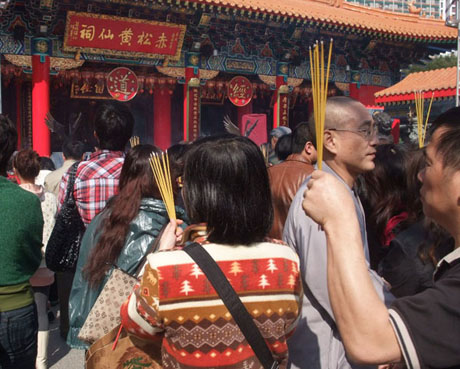
Worshippers at the main altar of the Taoist Wong Tai Sin Temple, Hong Kong's busiest temple
PASSPORT AND VISA REQUIREMENTS:
The Hong Kong SAR Government adopts a very liberal policy towards visitors and nationals of about 170 countries and territories can visit Hong Kong visa-free for business, social or pleasure purposes for a period of between 7 and 180 days. A list of countries/territories and details of visa-free period allowed or whether is required can be found here;
http://www.immd.gov.hk/eng/services/visas/visit-transit/visit-visa-entry-permit.html
All visitors are required to have a valid passport to enter Hong Kong and for most visitors this must be valid for a period of one month following date of departure from Hong Kong. The current passport validity requirement of the Immigration Department is;
"Passports or travel documents other than documents issued to stateless persons and refugees must be valid at least 1 month after period of intended stay. Documents issued to stateless persons must be valid at least 2 months after the period of intended stay. Documents issued to refugees are only valid in combination with a valid visa and valid documents for next destination."
Separate arrangements apply for visitors from Mainland China who can visit for a period of from 7 to 90 days but are required to obtain Exit-Entry Permits from the mainland authorities.
FREQUENT VISITORS to Hong Kong who have visited at least three times, by air, in the preceding twelve months or are members of some airline frequent flyer schemes can apply to enrol to use the Frequent Visitor e-Channel which allows use of dedicated self-service channels for immigration clearance;
http://www.immd.gov.hk/eng/services/echannel_visitors.html
Under reciprocal arrangements between the respective governments holders of passports of the Republic of Korea, Republic of Singapore, Federal Republic of Germany and Australia are also able to enrol for e-Channel automated immigration clearance.
Enrolled users of the Frequent Visitor e-Channel are eligible to use Frequent Visitor e-Channels at border control points at Hong Kong International Airport, Lo Wu, Lok Ma Chau, Lok Ma Chau Spur Line, Hung Hom, Shau Tau Kok, Shenzhen Bay, Man Kam To, Kai Tak Cruise Terminal, Macau Ferry Terminal, China Ferry Terminal, Express Rail Link West Kowloon Station, Hong Kong - Zhuhai - Macao Bridge and Heung Yuen Wai. 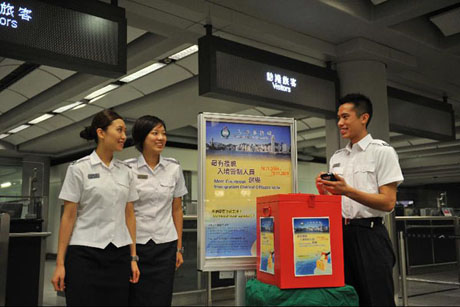
Hong Kong's Immigration Department prides itself on its welcoming, courteous and efficient service to visitors. Each year visitors arriving at Hong Kong International Airport are invited to vote for the "Most Courteous Immigration Control Officer" who is then appointed "Hong Kong Courtesy Ambassador" by Hong Kong Tourism Board
CONSULAR REPRESENTATION IN HONG KONG:
As at February 2024 there were 62 Consulates-General, 51 Honorary Consulates and 8 Officially Recognised Bodies in Hong Kong. Full details can be found on the Hong Kong Government's Protocol Division Government Secretariat website;
https://www.protocol.gov.hk/en/posts_bodies.html
xxxxxxxxxxxxxxxxxxxxxxxxxxxxxxxxxxxxxxxxxxxxxxxxxxxxxxxxxxxxxxxxxxxxxxxxxxxxxxxxxxxxxxxxxxxxxxxxxxxxxxxxxxxxxxxxxx
ANNUAL VISITOR ARRIVALS 2024
TOTAL – 44,502,797
BY COUNTRY / TERRITORY (10,000 visitors and over)
Mainland China - 34,043,127 Taiwan - 1,244,610 Philippines - 1,194,446 Macao - 1,163,742 United States - 884,262 South Korea - 854,873 Japan - 560,169 Thailand - 521,645 Singapore - 466,071 Malaysia - 405,508 India - 377,792 Australia - 370,857 Canada - 320,631 United Kingdom - 294,438 Germany - 168,115 France - 144,651 Russia - 131,598 Netherlands - 79,940 Italy - 67,916 New Zealand - 66,163 Spain - 49,628 Brazil - 44,294 Switzerland - 33,843 Mexico - 30,677 South Africa - 29,369 Turkey - 22,642 Sweden - 21,532 Portugal - 21,134 Belgium - 20,451 Austria - 15,678 Israel - 15,283 Finland - 12,477 Denmark - 11,919 Argentina - 11,462
Others - 801,854
Source – Hong Kong Tourism Board / The Immigration Department of the Hong Kong Special Administrative Region (January 2025)
ANNUAL VISITOR ARRIVALS 2019 - 2023:
ANNUAL VISITOR ARRIVALS 2023 (For the early part of 2023
entry to Hong Kong was subject to restrictions with testing and quarantine
requirements owing to the COVID-19 pandemic);
Total – 33,999,600
BY COUNTRY/TERRITORY - 5,000 visitors and over;
Mainland China 26,760,453 Macau SAR 1,206,795 Taiwan
783,778 Philippines
763,778
United States
594,752 Thailand
450,372 South Korea
402,999
Singapore
400,029 Japan
346,389 Malaysia
258,191
Australia
240,705 United Kingdom
212,286 Canada
209,028
India 207,655 Germany
106,767
France 86,255 Russia
56,063
Netherlands
49,530
New Zealand
43,734
Italy 40,252 Spain
28,276
Brazil 25,170 Switzerland
23,831 Mexico
19,801 South Africa
19,256
Israel 17,902 Portugal
16,325 Sweden16,285 Turkey
15,868 Belgium
13,288 Austria
9,953 Denmark
8,947 Finland
8,529 United Arab Emirates
8,035 Norway 6,761
Others 541,562
Source: Hong Kong Tourism Board / The Immigration
Department of the Hong Kong Special Administrative
Region (January 2024)
ANNUAL VISITOR ARRIVALS 2022 (For much of 2022 entry to Hong Kong was severely restricted and at times restricted to Hong Kong residents only and with strict quarantine requirements owing to the COVID-19 pandemic);
Total - 604,564
BY COUNTRY/TERRITORY - 1,000 visitors and over;
Mainland China 357,130
United States 25,987
Taiwan 24,249
Philippines 21,046
Singapore 15,198
United Kingdom 12,876
Thailand 12,662
Australia 12,039
India 10,654
Macau SAR 10,225
Canada 10,189
Malaysia 8,731
South Korea 8,348
Japan 7,316
France 4,496
Germany 4,275
Netherlands 2,559
New Zealand 2,134
Italy 1,947
Brazil 1,343
Israel 1,277
Argentina 1,216
Switzerland 1,068
South Africa 1,014
Others 46,585
Source: Hong Kong Tourism Board / The Immigration Department of the Hong Kong Special Administrative Region (January 2023)
ANNUAL VISITOR ARRIVALS 2021 (For most of 2021 entry to Hong Kong was severely restricted and mostly restricted to Hong Kong residents only and with strict quarantine requirements owing to the COVID-19 pandemic);
Total - 91,398
BY COUNTRY/TERRITORY - 100 visitors and over;
Mainland China 65,721
Philippines 4,065
Taiwan 2,547
India 2,388
Macau SAR 1,922
Ukraine 1,722
Indonesia 1,504
United States 1,365
Canada 845
Russia 783
Singapore 701
United Kingdom 677
South Korea 626
Australia 569
Japan 346
Romania 336
Germany 318
Malaysia 317
France 289
Poland 271
Tanzania 252
Croatia 236
Thailand 231
Italy 216
Montenegro 192
New Zealand 175
Netherlands 164
Turkey 146
Spain 145
Israel 137
Myanmar 133
Greece 123
Denmark 121
Bulgaria 115
Sweden 110
Others 1,590
Source: Hong Kong Tourism Board / The Immigration Department of the Hong Kong Special Administrative Region (January 2022)
ANNUAL VISITOR ARRIVALS 2020 (2019 figures in brackets):
Total – 3,568,875 (55,912,609)
BY COUNTRY/TERRITORY -1,000 visitors and over;
Mainland China 2,706,398 (43,774,685)
Macau SAR 117,696 (1,238,709)
Taiwan 105,140 (1,538,915)
United States 80,825 (1,107,165)
Philippines 62,741 (875,897)
Japan 50,320 (1,078,836)
Australia 47,255 (505,253)
United Kingdom 44,405 (518,378)
South Korea 39,922 (1,042,540)
Canada 27,951 (318,479)
Indonesia 25,750 (375,781)
India 24,593 (337,997)
Thailand 23,152 (467,048)
Singapore 22,664 (453,182)
Malaysia 20,771 (392,562)
Russia 20,121 (138,679)
Germany 15,493 (217,779)
France 13,307 (177,768)
New Zealand 8,728 (92,422)
Netherlands 6,639 (85,227)
Italy 6,156 (89,783)
Israel 5,092 (69,269)
South Africa 4,608 (59,865)
Spain 4,495 (60,646)
Brazil 4,108 (48,500)
Switzerland 4,079 (52,414)
Sweden 4,040 (43,506)
Mexico 3,024 (34,919)
Portugal 2,985 (27,510)
Belgium 2,288 (29,555)
Finland 2,137 (21,471)
Denmark 2,126 (22,809)
Austria 1,548 (22,136)
Norway 1,476 (18,303)
Vietnam 1,168 (44,406)
Argentina 1,158 (13,081)
Others 54,516
Source: Hong Kong Tourism Board / The Immigration Department of the Hong Kong Special Administrative Region (January 2021)
xxxxxxxxxxxxxxxxxxxxxxxxxxxxxxxxxxxxxxxxxxxxxxxxxxxxxxxxxxxxxxxxxxxxxxxxxxxxxxxxxxxxxxxxxxxxxxxxxxxxxxxxxxxxxxxxxxxxx
xxxxxxxxxxxxxxxxxxxxxxxxxxxxxxxxxxxxxxxxxxxxxxxxxxxxxxxxxxxxxxxxxxxxxxxxxxxxxxxxxxxxxxxxxxxxxxxxxxxxxxxxxxxxxxxxxxxxx
LONGEST BRIDGES*:
TSING MA BRIDGE, 1377 metres, opened 1977 (the world’s ninth longest suspension bridge and forming part of the Lantau Link providing road and rail access to Hong Kong International Airport
KAP SHUI MUN BRIDGE, 1323 metres, opened 1997 and forming part of the Lantau Link providing road and rail access to Hong Kong International Airport
TING KAU BRIDGE, 1177 metres, opened 1998 and linking the western New Territories to the Tsing Ma Bridge and Lantau Link
STONECUTTERS BRIDGE, 1018 metres, opened 2009 (the world’s second longest cable-stayed bridge) linking Tsing Yi to Stonecutters Island and forming part of Strategic Route 8 providing road access between the eastern New Territories and the Lantau Link to Hong Kong International Airport
*The above bridges are wholly within the Hong Kong SAR boundary. Additionally the HONG KONG – SHENZHEN WESTERN CORRIDOR linking Hong Kong and Shenzhen on Mainland China includes a 4770 metre bridge (“Shenzhen Bay Bridge”), opened 2007 across Deep Bay. The Hong Kong section of the bridge is 3200 metres. The main bridge section of the HONG KONG - ZHUHAI - MACAU BRIDGE/TUNNEL, opened 2018, lies outside the Hong Kong SAR boundary although the Hong Kong Link Road is within the boundary.
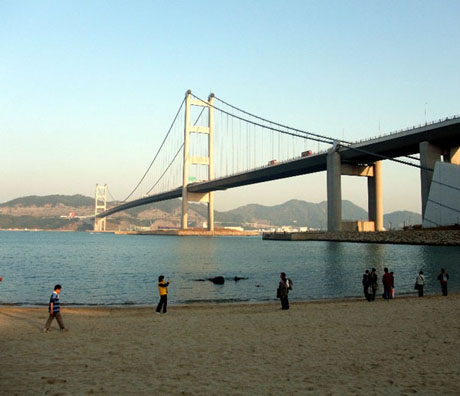
Most visitors to Hong Kong will travel across Hong Kong's longest bridge, the Tsing Ma Bridge on their journey to and from the airport. The bridge, which forms part of the Lantau Link, was built to provide access to the airport and carries road traffic on its upper deck and rail traffic on its enclosed lower deck which also has road carriageways for use in the event of adverse weather or emergencies
LONGEST TUNNELS:
TUEN MUN - CHEK LAP KOK TUNNEL, 5km, opened 27th December 2020, subsea road tunnel forming part of the Tuen Mun - Chek Lap Kok Link connecting the Northwest New Territories, Hong Kong Zhuhai Macau Bridge, North Lantau and Hong Kong International Airport
LUNG SHAN TUNNEL, 4.8km, opened 26th May 2019, on the Heung Yuen Highway linking Fanling Highway with Heung Yuen Wai Border Control Point
TATE’S CAIRN TUNNEL, 3.9km, opened 1991, linking Diamond Hill, Kowloon with Siu Lek Yuen, Sha Tin, New Territories
TAI LAM TUNNEL, 3.8km, opened 1998, linking Ting Kau, Tsuen Wan, New Territories with Au Tau, Yuen Long, New Territories
EAGLE’S NEST TUNNEL, 2.7km, opened 2008, linking Cheung Sha Wan, Kowloon and Sha Tin, New Territories and forming part of Strategic Route 8
SHING MUN TUNNELS, 2.6km, opened 1990, linking Tsuen Wan, New Territories and Sha Tin, New Territories and forming part of Strategic Route 9
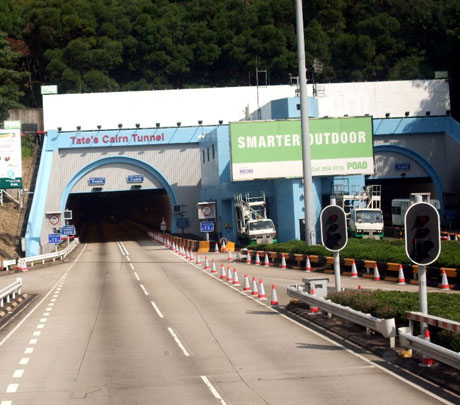
Diamond Hill entrance to Tate's Cairn Tunnel, Hong Kong's longest tunnel since 1991 until the opening of Lung Shan Tunnel in 2019
TALLEST BUILDINGS:
INTERNATIONAL COMMERCE CENTRE (ICC), West Kowloon, 484-metres, 118-storey, completed 2010
TWO INTERNATIONAL FINANCE CENTRE (Two IFC), Central, 416-metres, 88-storey, completed 2003
CENTRAL PLAZA, Wan Chai, 374-metres (including antenna), 78-storey, completed 1992
BANK OF CHINA TOWER, Central, 368-metres (including antenna 52-metres), 70-storey, completed 1988
THE CENTER, Central, 350-metres, 80-storeys, completed 1999
NINA TOWER, Tsuen Wan, 319-metres, 80-storey, completed 2007
ONE ISLAND EAST, Island East, 298-metres, 69-storey, completed 2008
CHEUNG KONG CENTER, Central, 283-metres, 62-storey, completed 2009
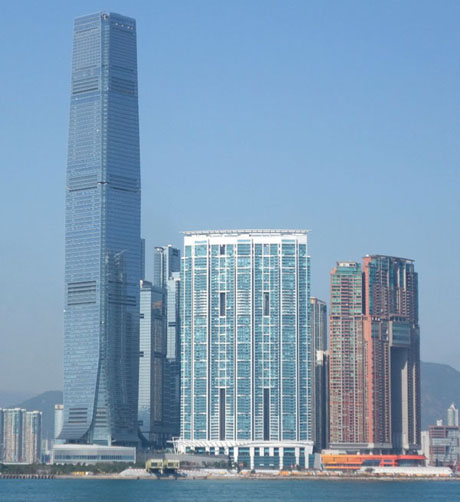
International Commerce Centre, West Kowloon, Hong Kong's tallest building and fourth tallest building in the world, stands out like a beacon, reflecting the late afternoon sun (view from Central and Western District Promenade, Sheung Wan on Hong Kong Island)
HIGHEST PEAKS AND MOUNTAINS:
TAI MO SHAN, New Territories, 957 metres
LANTAU PEAK (Fung Won Shan), Lantau Island, 934 metres
SUNSET PEAK (Tai Tung Shan), Lantau Island, 869 metres
SZE FONG SHAN, New Territories, 785 metres
WO YANG SHAN, New Territories, 771 metres
On Hong Kong Island the highest peak is VICTORIA PEAK, 552 metres (the 31st highest peak in Hong Kong)
On Kowloon the highest peak is KOWLOON PEAK (Fei Ngo Shan), 602 metres (the 18th highest peak in Hong Kong)
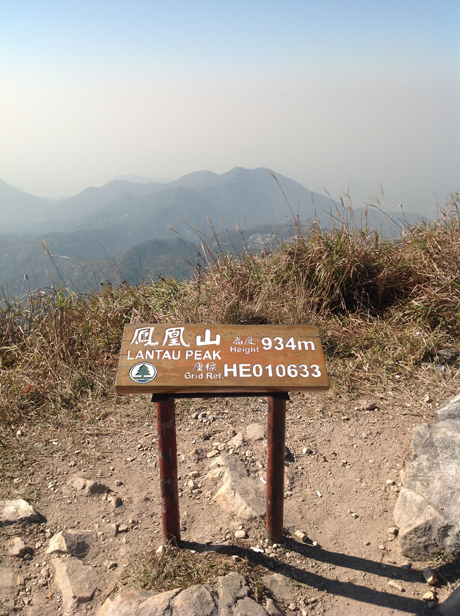
Lantau Peak at 934-metres is Hong Kong's second highest peak