BUS SERVICES IN HONG KONG
SEE ALSO "OPEN-TOP SIGHTSEEING BUS TOURS"
Hong Kong has an extensive network of public bus services covering almost all areas of Hong Kong Island, Kowloon, the New Territories and Lantau Island.
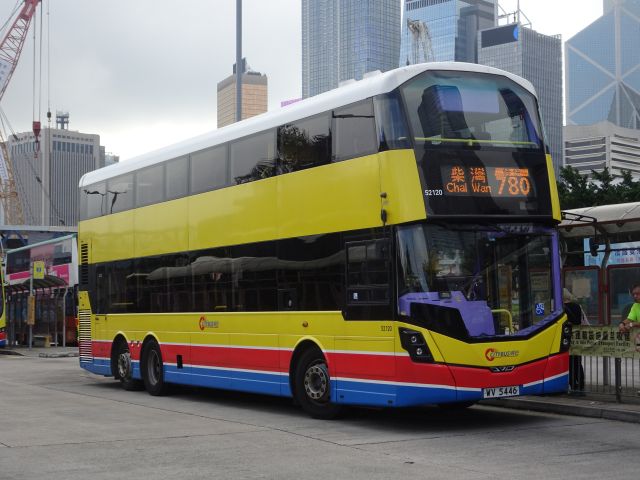
Citybus bus awaiting departure on route 780 at Central Piers Bus Terminus
The operation of bus services can be traced back to the 1920's when, in 1921, the Vehicles and Traffic Regulation Ordinance set out the fares, stopping points and bus specifications for four bus routes serving Kowloon. The first franchises were awarded in 1933 to China Motor Bus Company Limited and Kowloon Motor Bus Company (1933) Limited (KMB). The third franchised bus company was New Lantao Bus Company (1973) Ltd which has operated franchised services on Lantau Island since 1974. In 1991 Citybus Limited, which since 1979 had operated a shuttle service for dockyard workers with a single bus and later, some residential services, was granted a franchise for operating one Hong Kong Island bus route previously operated by CMB and acquired further routes from 1993 and 1995. In 1998 CMB's history of operating franchised bus services came to an end* when New World First Bus Services Limited (NWFB), a new operator in Hong Kong, won the tender to operate 88 routes previously operated under CMB's franchise. In 1996, with the opening of the Lantau Link serving the new Hong Kong International Airport at Chek Lap Kok, Long Win Bus Company Limited, a subsidiary of Kowloon Motor Bus Holdings Limited, and Citybus were awarded the franchises to operate services for airport and North Lantau routes.
* after losing its franchise CMB operated a private free shuttle bus service on six days a week between North Point Government Offices and Island Place at North Point from 1998 until ceasing operation on 30th June 2015.
Currently Hong Kong's franchised bus network is made up of about 600 routes, operated under six franchises by five franchised bus companies with a total fleet of 5,870 licensed franchised buses (at end of 2024), comprising 5,613 double-deck and 257 single-deck vehicles. Each day franchised buses make over 80,000 journeys with a patronage of about four million passengers. Under current legislation, franchised buses must be retired from service before reaching an age of 18 years. At the end of 2022 there were 26,113 franchised bus licence holders. From 1st July 2023 the number of franchises was reduced from six to five when the bus networks of Citybus (Hong Kong Island and Cross-Harbour services) were merged with those of New World First Bus under a new franchise in the name Citybus Limited (Franchise for the Urban and New Territories bus network).
CURRENT FRANCHISED BUS OPERATORS;
THE KOWLOON MOTOR BUS COMPANY (1933) LIMITED
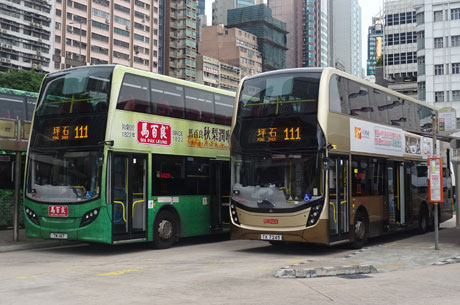
KMB buses at Macau Ferry Bus Terminus, Connaught Road Central
The Kowloon Motor Bus Company (KMB) was founded in 1921 and originally operated nine 16-seat Ford buses on routes between Tsim Sha Tsui, Sham Shui Po and Hung Hom. KMB later merged with Nam Hing Bus Company, Cheung Mei Bus Company and Chung Hing Motor Bus Company and subsequently bought Kai Tack Motor Bus Company to form The Kowloon Motor Bus Company (1933) Limited in 1933 and was awarded the 15 year franchise to operate bus services in Kowloon and the New Territories in the same year. The company is also the joint operator with Citybus and New World First Bus of some franchised cross-harbour routes and was also the first recorded operator of bus services on Lantau Island from 1960 until surrendering the franchise in 1965.
After restructuring in 1997 Kowloon Motor Bus Holdings Limited was established and became the ultimate holding company of the KMB Group. As part of the restructuring the subsidiary company Long Win Bus Company Limited was established to operate franchised bus services between the New Territories and the new Hong Kong International Airport at Chek Lap Kok. KMB also operates a shuttle service between the New Territories town of Tin Shui Wai and the Lok Ma Chau Spur Line Control Point at the border with mainland China. In 2005 Kowloon Motor Bus Holdings Limited was renamed Transport International Holdings Limited.
Commencing in July 2017 KMB began rolling out a new red and silver livery which also features an outline of Hong Kong skyscrapers and the slogan "Heartbeat of the City". The livery has first appeared on a fleet of 70 new buses which are equipped with USB ports, free Wi-Fi and screens on the lower deck indicating the number of vacant seats upstairs.
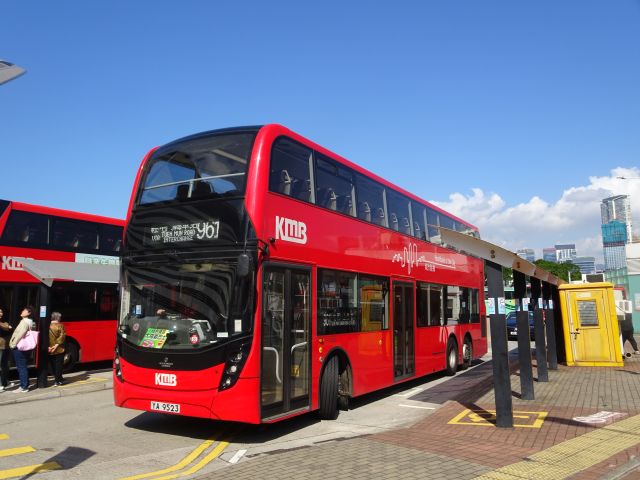
KMB bus at Wan Chai (HKCECE) Bus Terminus in current livery, introduced in July 2017
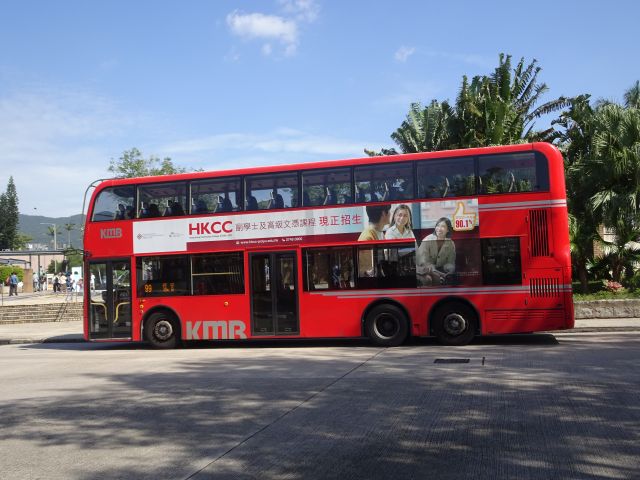
KMB bus at Sai Kung Bus Terminus awaiting departure on route 92 to Diamond Hill

KMB Alexander Dennis Green Liveried Zero Carbon Bus at Star Ferry Bus Terminus, Tsim Sha Tsui
KMB's current ten year franchise runs from 1st July 2017 until 1st July 2027.
KMB daily passenger patronage in 2024 was about 2,569,000.
At the end of 2024 KMB operated a fleet of 3,867 double-deck buses and 141 single-deck buses.
Website;
http://www.kmb.hk/en/
LONG WIN BUS COMPANY LIMITED
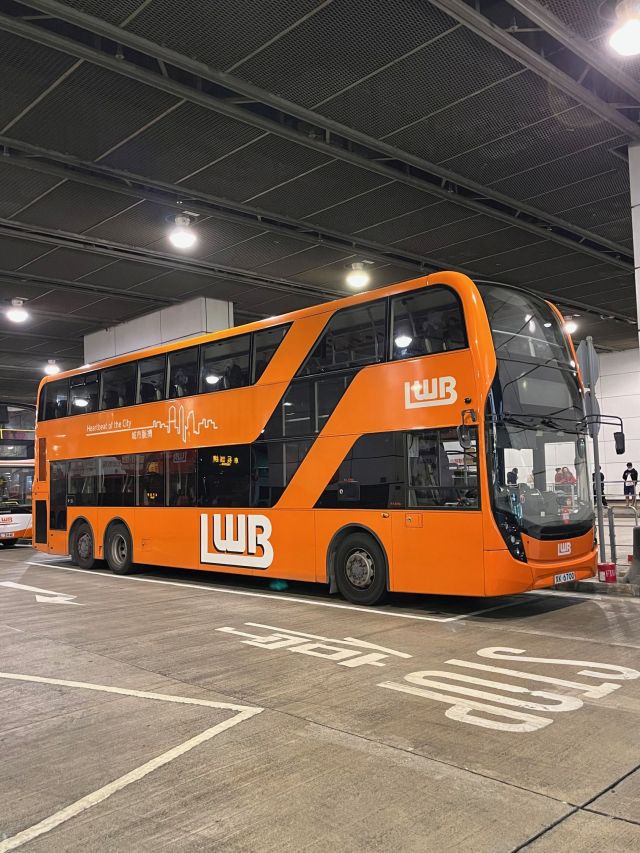
Long Win S1 airport shuttle route bus at Tung Chung Station Bus Terminus
Long Win Bus Company Limited was formed as a subsidiary company of KMB Holdings Limited (now Transport International Holdings Limited) in 1998. KMB had been the preferred operator by the government when inviting tenders for franchised bus services between the new Hong Kong International Airport, North Lantau and the New Territories and Long Win was set up as a separate company to specifically to operate these services. Its services are branded "Airbus" and in addition to its "A" prefix limited stop services to and from the airport, it operates "E" prefix "external" route local services between the airport, Tung Chung and some New Territories towns and also jointly operates with Citybus, shuttle services between the airport and surrounding area including Tung Chung and AsiaWorld-expo and between the Lantau Link Toll Plaza and Hong Kong Disneyland. For further information about airport bus services see TO/FROM AIRPORT.
Long Win bus services carried about 132,400 passengers daily in 2024.
In July 2022 the government granted the company a new 10-year franchise to run from 1st May 2023 to 1st May 2033. At the end of 2024 Long Win operated a fleet of 279 double-deck buses and 2 single-deck buses.
Website;
http://www.lwb.hk/en/
CITYBUS LIMITED
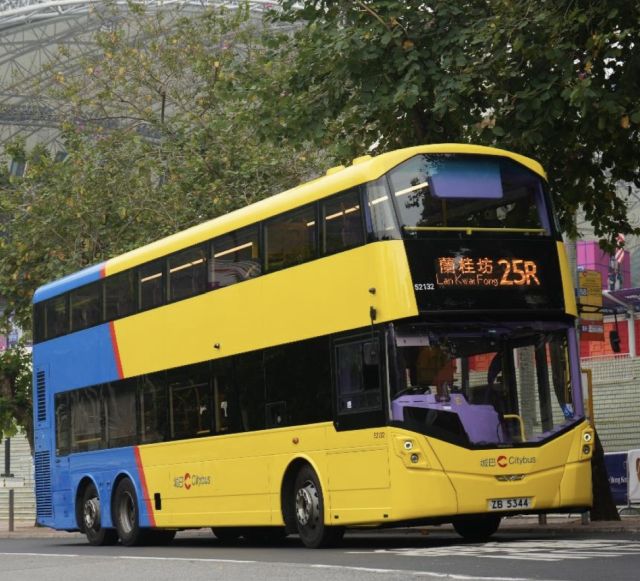
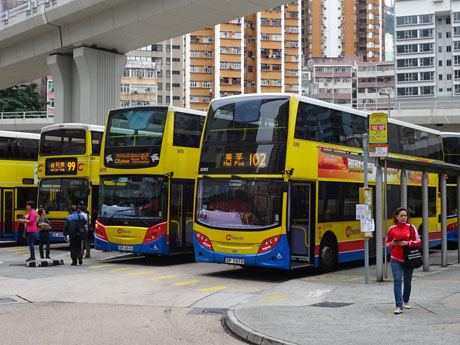
Citybus buses at Shau Kei Wan Bus Terminus
Citybus was established in 1979 as a small non-franchised bus operator with a single bus operating a shuttle service for workers of United Dockyards but later expanded into other private and contract hire services including a few residential coach routes. In 1991 the company broke the monopoly held since 1933 by China Motor Bus Company (CMB) for franchised services on Hong Kong Island when it was awarded the franchise to operate route 12A. Subsequently a further 28 routes previously operated by CMB were transferred to Citybus in 1993, followed by 14 in 1997 and 12 more in 1998. Citybus also bid for the remaining 88 CMB routes in 1998 after the government had decided not to offer the company a new franchise following continuing dissatisfaction with CMB but the tender was awarded to New World First Bus, which since 2004 has been part of the same group as Citybus. The name New World First Bus (NWFB) disappeared from 1st July 2023 when a new franchise in the name Citybus Limited took effect merging
the operations of NWFB with those of Citybus' Hong Kong Island and Cross-Harbour bus network.
In 1996 Citybus won the tender to operate franchised bus services from 1998 between the new Hong Kong International Airport at Chek Lap Kok and urban districts of Hong Kong Island and Kowloon, which it operates under the "A" prefix premuim "Cityflyer" brand, as well as "E" prefix "external" local services between the airport, Tung Chung, Hong Kong Island and Kowloon. It also operates shuttle services between the New Territories town of Tuen Mun and the Shenzhen Bay Control Point at the mainland border as well as jointly operating with Long Win Bus Company, local shuttle services between the airport and surrounding area including Tung Chung and AsiaWorld-expo and between the Lantau Link Toll Plaza and Hong Kong Disneyland. In 2018 Citybus was awarded a franchise for a shuttle bus feeder service for the Hong Kong - Macau - Zhuhai Bridge operating between Sunny Bay Station and Hong Kong Port. For further information about airport bus services see TO/FROM AIRPORT. Citybus also jointly operates with Kowloon Motor Bus (KMB) some cross-harbour routes between Hong Kong Island and the New Territories.
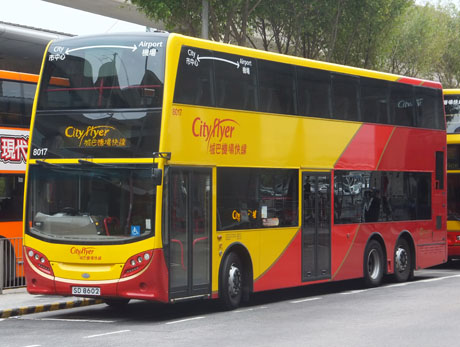
"Cityflyer" buses operated by Citybus offer premium limited stop services on routes serving Hong Kong International Airport with luxury reclining seats, capacious luggage space with CCTV coverage, free wifi and bus stop announcement systems
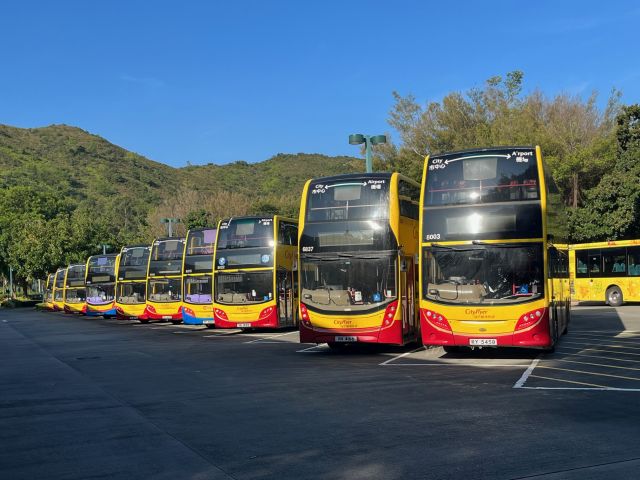
Fleet of Citybus "Cityflyer" buses parked at Hong Kong Disneyland, November 2023
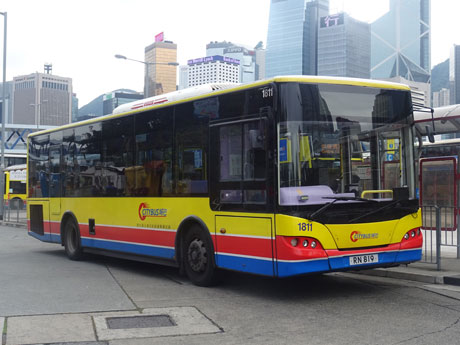
Citybus single-deck bus at Central Ferry Piers Bus Terminus
Citybus had been taken over in 1999 by UK based transport operator Stagecoach Group which subsequently, in 2003, sold its interest in Citybus to Delta Pearl Limited, a subsidiary of Chow Tai Fook Enterprises, the major shareholder in NWS Holdings. Chow Tai Fook and NWS Holdings formed a new company for its transport operations, Merryhill Group Limited in March 2004 and Citybus became part of that group, which was subsequently renamed NWS Transport Services Limited, a part of NWS Holdings, in December 2004. NWS Transport Services is also the parent company of Hong Kong bus operator New World First Bus (NWFB). In August 2020 Citybus and NWFB were sold by NWS Holdings tor HK$3.2 billion to a private equity consortium, Templewater Bravo, founded by Investec Bank and a former senior vice-president at conglomerate Chow Tai Fook Enterprises. In February 2021 the new owners merged the management teams of Citybus and NWFB and in May 2021 it was reported that the bus operations would be merged with a new common livery for the buses and the same uniform for frontline staff. The merger formally formally took place on 1st July 2023 following Transport Department approval when two of the three franchises were renewed.
In May 2024 Hans Energy became the majority shareholder in Citybus' parent company Bravo Transport Holdings Limited, acquiring a 54.44% holding giving it 70% ownership with the remaining 30% ownership held by Hong Kong-based private-equity firm Templewater, which acquired Bravo Transport and Citybus in 2020. It will become a minority shareholder of Hans Energy, with around 6.59 per cent of the equity shares issued at HK$0.7961 per share. Hans Energy, which trades refined oil and petrochemical products and owns a loading terminal, jetties and fuel storage tanks in Dongguan, Guangdong province, is transitioning its focus from the traditional energy sector to renewable energy. In 2023 Hans Energy invested in Hong Kong’s first hydrogen refuelling station which allowed Citybus’s first hydrogen-powered double-decker bus to enter service in early 2024. Templewater, launched a decarbonisation fund in May 2024 focusing on investing in hydrogen, energy storage and carbon capture, utilisation and storage, will continue to serve on the board of Bravo Transport and Citybus, to advise on business development, acquisitions, and new energy and hydrogen-related projects.
With effect from 9th May 2021 passengers on all Citybus and NWFB franchised bus routes will be able to pay fares by QR code using Alipay HK "EasyGo", Alipay "Transit QR Code"* or UnionPay "Transit QR Code*
* set to Hong Kong travel area.
Adult fares are pre-set on the QR code payment system with a fare concession button for child and elder fares. The system will display "Approved" on the screen with a voice message when the transaction is complete. The QR code system cannot yet be used to make concessionary fare payment under the Government Public Transport Fare Concession Scheme for Elderly (age 65 and over) and Eligible Persons with Disabilities and Octopus should continue to be used for passengers wishing to benefit from this scheme. Passengers age 60-64 wishing to benefit from the HK$2 fare concession on Citybus Hong Kong Island and Cross-Harbour (not airport or North Lantau) routes on Sundays and public holidays must continue to use Personalised Octopus for fare payment.
The Citybus / NWFB e-payment system was extended to include contactless credit card and mobile credit card payment by the end of 2021.
In September 2015 the government granted Citybus a new 10-year franchise for its Hong Kong Island and Cross-Harbour services to commence 1st June 2016 on expiry of the current franchise and run until 1st June 2026.
In July 2022 the expiry date of the Citybus franchise was brought forward to 1st July 2023, the same date as expiry of the current New World First Bus franchise. At the same time a new 10-year franchise running from 1st July 2023 to 1st July 2033 was awarded in the name of Citybus Limited (Franchise for the Urban and New Territories bus network) covering the two existing bus networks of Citybus (Hong Kong Island and North Lantau) services and New World First Bus.
A new franchise for airport services was awarded in 2013 and expired in May 2023. In July 2022 the government confirmed it had awarded Citybus a new 10-year franchise for its Airport and North Lantau services to commence 1st May 2023 and run until 1st May 2033.
Citybus began accepting fare payment by WeChat Pay HK (HKD Wallet) and Weixin Pay (RMB Wallet) with effect from 14th January 2024. Adult fares are pre-set on the e-Payment system. Children under 12 and eligible senior citizens aged 65 or above can benefit from fare concession by pressing the touch screen button before scanning WeChat Pay HK or Weixin Pay QR codes.
In April 2024 Citybus announced it would recruit 20 non-local bus captains from mainland China to operate its non-franchised services including employee shuttles, sightseeing tours and rental operations. The recruits would not operate franschised routes.
In April 2024 Citybus expanded its network by operating new franchised routes in the New Territories East in the Ma On Shan and Sai Sha areas with routes 581 and 582 including a bus/bike interchange scheme.
At the end of 2024 Citybus daily passenger patronage was about 881,500 for its Hong Kong Island and Cross-Harbour and New Territories franchise which includes routes previously operated by NWFB and about 98,500 for its Airport annd North Lantau routes.
At the end of 2024 Citybus operated a fleet of 1,538 double-deck and 14 single-deck buses of which 1,312 double-deck and all 26 single-deck buses were allocated to its Hong Kong Island and Cross-Harbour franchise and Urban and New Territories franchise* and 226 double-deck buses were allocated to its Airport and North Lantau franchise.
* The franchises of NWFB and Citybus (Hong Kong Island and Cross-Harbour) were merged on 1st July 2023 and the NWFB bus fleet was transferred to Citybus (Hong Kong Island and Cross-Harbour) franchise fleet.
Website;
https://www.citybus.com.hk/home/
NEW WORLD FIRST BUS SERVICES LIMITED (MERGED WITH CITYBUS 1st JULY 2023 - SEE ABOVE)
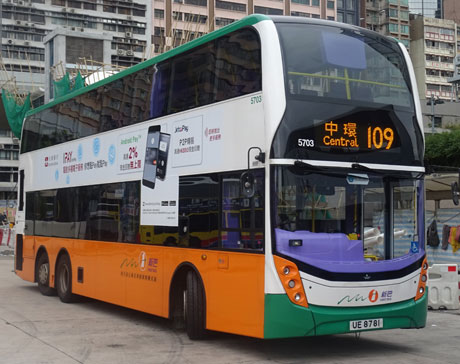
New World First Bus in livery prior to merger with Citybus waiting to depart from Macau Ferry Bus Terminus on route 109 in December 2023
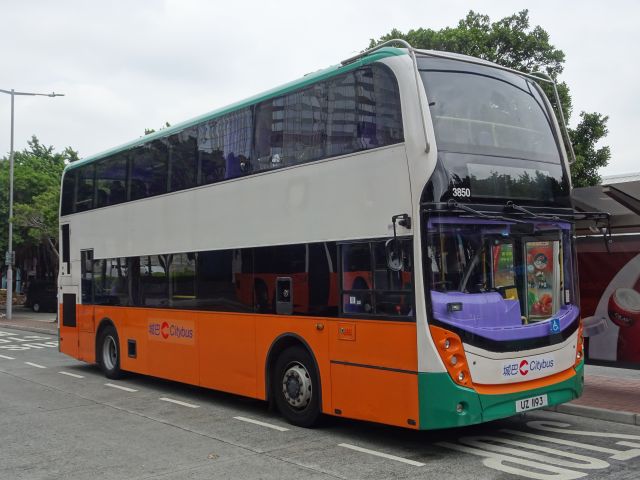
Following its merger with Citybus in July 2023 NWFB bus fleet has retained its existing livery but been rebranded with Citybus logos. Bus seen at Central Pier 5
New World First Bus Services (NWFB) was established in 1998 as a consortium led by Hong Kong conglomerate New World Enterprises and which included the large UK based transport operator FirstGroup. The company was established to bid for routes on Hong Kong Island operated by China Motor Bus (CMB) which had been put out to tender following increasing public and government dissatisfaction with its services. In March 1998 NFWB was awarded the franchise to operate 88 CMB routes with effect from 1st September 1998. On being awarded the franchise NWFB immediately placed orders for 243 new buses, subsequently increased to 500. It was, however, possible to source only 62 new vehicles for the beginning of services and in August 1998 NWFB purchased 710 buses from CMB. In April 2000 FirstGroup withdrew from the consortium and sold its interest to NWS Holdings but NWFB kept its original trading name and continued to follow the development plans which it had agreed whilst in partnership with FirstGroup. In March 2004 NWFB became a member of Merryhill Group Limited, a new company established jointly by NWS Holdings and Chow Tai Fook Enterprises Limited which was renamed NWS Transport Services Limited, part of NWS Holdings, in December 2004. In August 2020 NWFB and Citybus were sold by NWS Holdings tor HK$3.2 billion to a private equity consortium, Templewater Bravo, founded by Investec Bank and a former senior vice-president at conglomerate Chow Tai Fook Enterprises. In February 2021 the new owners merged the management teams of Citybus and NWFB and in May 2021 it was reported that the bus operations will be merged with a new common livery for the buses and the same uniform for frontline staff and in July 2022 it was confirmed that a new franchise has been awarded for 10 years from 1st July 2023 in the name Citybus Limited (Franchise for the Urban and New Territories bus network) effectively merging the operations of NWFB with Citybus. In order to achieve this the expiry date of Citybus existing Hong Kong Island and Cross-Harbour franchise was brought forward to 1st July 2023 when the name New World First Bus will disappear.
With effect from 9th May 2021 passengers on all Citybus and New World First Bus (NWFB) franchised bus routes will be able to pay fares by QR code using Alipay HK "EasyGo", Alipay "Transit QR Code"* or UnionPay "Transit QR Code*
* set to Hong Kong travel area.
Adult fares are pre-set on the QR code payment system with a fare concession button for child and elder fares. The system will display "Approved" on the screen with a voice message when the transaction is complete. The QR code system cannot yet be used to make concessionary fare payment under the Government Public Transport Fare Concession Scheme for Elderly (age 65 and over) and Eligible Persons with Disabilities and Octopus should continue to be used for passengers wishing to benefit from this scheme. Passengers age 60-64 wishing to benefit from the HK$2 fare concession on Citybus Hong Kong Island and Cross-Harbour (not airport or North Lantau) routes on Sundays and public holidays must continue to use Personalised Octopus for fare payment.
The Citybus / NWFB e-payment system had been extended to include contactless credit card and mobile credit card payment by the end of 2021.
NFWB services operate mainly on Hong Kong Island but also operates some routes wholly within the eastern New Territories and jointly operates some cross-harbour routes to Kowloon and the New Territories with KMB.
NWFB's current franchise took effect in 2013 and expires in July 2023. In July 2022 the government awarded a new 10-year franchise to run from 1st July 2023 to 1st July 2033 in the name Citybus Limited (Franchise for the urban and New Territories bus network) effectively merging the operations covered by the existing NWFB and Citybus (Hong Kong Island and Cross-Harbour networks).
The final NWFB service to operate before its merger with Citybus was the route 970X departure at 1030am from Cheung Sha Wan to Aberdeen on 1st July 2023.
NWFB services carried about 354,000 passengers daily during 2022.
At the end of 2022 NWFB operated a fleet of 634 double-deck and 6 single-deck buses. At the time of the merger between NWFB and Citybus on 1st July 2023 NWFB operated 2 single-deck and 211 double-deck buses which were transferred to the Citybus fleet for its Urban and New Territories franschise.
Website;
http://www.bravobus.com.hk/home/
NEW LANTAO BUS COMPANY (1973) LIMITED
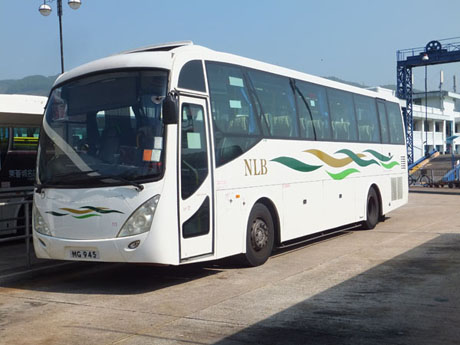
New Lantao Single-Deck Bus at Mui Wo Bus Terminus
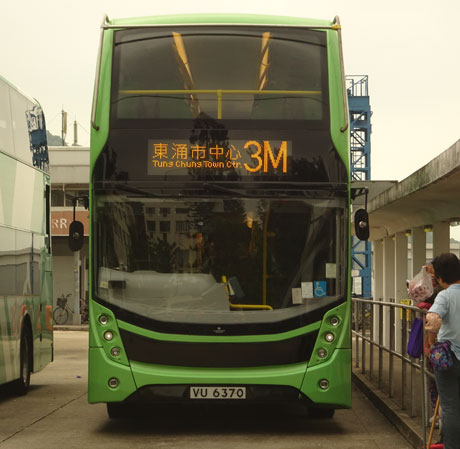
Double-Deck NLB bus on route 3M Mui Wo - Tung Chung at Mui Wo Ferry Pier Bus Terminus. Double-deck buses have only been permitted to travel this route since 2019 following improvements to the steep and winding Tung Chung Road across the island and extensive trials.
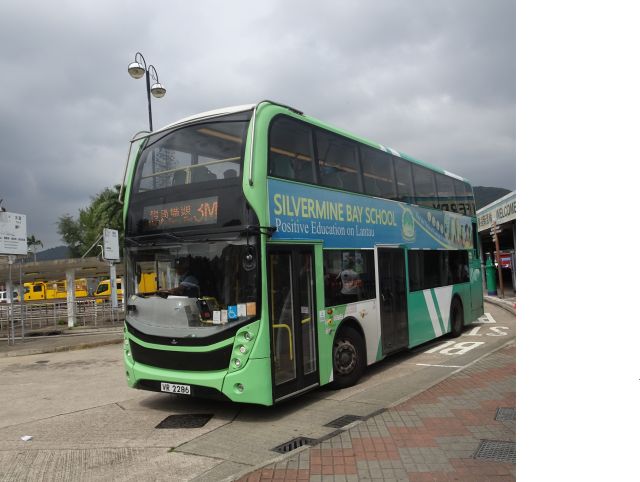
NLB Double-Deck bus seen on arrival at Mui Wo Ferry Pier from Tung Chung on route 3M in November 2023
New Lantao Bus Company (1973) Limited (NLB) was formed by amalgamation of existing Lantau Island bus operators United Lantao Bus Company, Ngong Ping Bus Company, Tai O Public Bus Company and Tai Long Wan Village Bus. United Lantao Bus had previously taken over two similarly named operators, Lantau Bus Co and Lantau Motor Bus Co. in 1967 and 1969 respectively. NLB commenced operating services under licence from 1973 until being awarded the exclusive franchise for operation of bus services on Lantau Island in 1974. Kowloon Motor Bus (KMB) had been the first operator of bus services on the island from 1960 until surrendering its franchise in 1965. Several local operators subsequently began services but quality of service declined and a serious accident led to the government demanding improvements to the organisation and financial operation of the bus companies which resulted in the formation of NLB. The company inherited 41 vehicles and four routes from the constituent companies. In 1992 NLB was aquired by Kwoon Chung Motors, a major operator of contract and private hire services in Hong Kong.
In 1998 NLB was authorised to operate a special airport service A35 between the new Hong Kong International Airport and South Lantau and extended its services into the new estates of the airport town of Tung Chung. The company also operates a shuttle service between Yuen Long in the New Territories and Shenzhen Bay Border Control Point. In 2018 NLB was awarded franchises for two feeder shuttle bus services for the Hong Kong - Macau - Zhuhai Bridge operating between Hong Kong International Airport / Asia World-Expo and Tung Chung and Hong Kong Port.
In September 2015 the Government awarded the company a new 10-year franchise to commence on 1st March 2017 and run until 1st March 2027.
Daily patronage at the end of 2024 was about 96,600
At the end of 2024 NLB operated a fleet of 75 single-deck and 67 double-deck buses.
Website;
http://www.newlantaobus.com/
OTHER BUS OPERATORS;
MTR LIGHT RAIL BUS ROUTES AND MTR FEEDER BUS
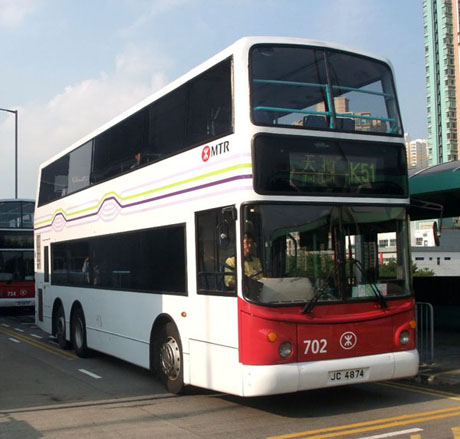
MTR bus at Siu Hong West Rail/Light Rail interchange at Tuen Mun in the northwest New Territories
In addition to services operated by the franchised bus operators, Hong Kong's rail operator, MTR operates 13 licensed bus routes in the northwest New Territories serving MTR West Rail Line and MTR Light Rail stations in the towns of Tuen Mun, Tin Shui Wai and Yuen Long and 4 local feeder bus routes serving Tai Po Market Station on MTR East Rail Line (operated by KMB on behalf of MTR) in the northeast New Territories. When transferring directly between MTR or Light Rail and MTR bus, the bus connection is free when using Octopus Card, subject to the connection being made within 60 minutes.
These services were previously operated by Kowloon-Canton Railway Corporation (KCRC) prior to its merger with MTR Corporation in 2007. KCRC had established its bus division in 1986 to provide feeder bus service within Tuen Mun and Yuen Long following construction of Light Rail network. KCRC Bus Division also acquired two free feeder services operated by KMB. KCRC and MTR merged in December 2007 and KCRC Bus Division was renamed MTR Bus Division.
The number of feeder bus routes has declined in recent years since the Public Transport Intermodal Coordination Policy (PTICP) introduced by the government in 1986 was relaxed. Under the PTICP rail was to become the heart of the public transport network and residents of the New Territories were encouraged to use rail by placing restrictions on the final stop of bus services from the New Territories to urban areas.
During 2016/2017 MTR introduced a new fleet of 68 11.3-metre long buses fitted with Euro V engines to replace existing buses which are being retired.
MTR Bus had a fleet of 152 buses (141 double-deck and 11 single-deck), as at end 2024 which carry about 162,000 passengers daily.
In June 2024 MTR introduced its first electric bus into service on route K54 connecting Wo Tin Estate, Siu Hong Station and Tuen Mun Town Centre. MTR plans to gradually replace its existing fleet of diesel buses and expects to have 30 electric buses in service by the end of 2026.
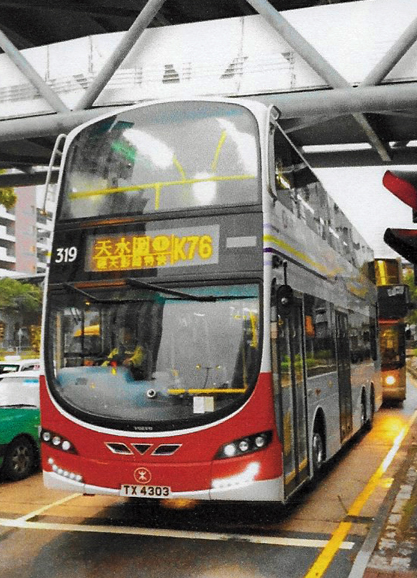
One of the first of 68 of MTR's new buses being introduced into service between January 2016 and the end of 2017
Website;
http://www.mtr.com.hk/en/customer/services/bus_rf_index.html
RESIDENTS BUS SERVICES (NON-FRANCHISED PUBLIC BUS SERVICES)
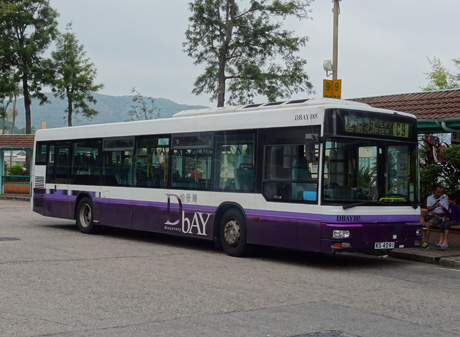
Residents' bus services as the Discovery Bay internal circular route C9, above, are bus services which can be used by the general public
As at January 2017 there were 1,095 buses licensed to provide Residents' Services on behalf of the owners, residents or management of residential developments. Residents' Services are a type of non-franchised public bus service, available to all, and include those operating in Discovery Bay and Ma Wan.
List of approved Residents' Services;
http://www.td.gov.hk/en/transport_in_hong_kong/public_transport/buses/non_franchised/list_of_approved_residents_services/index.html 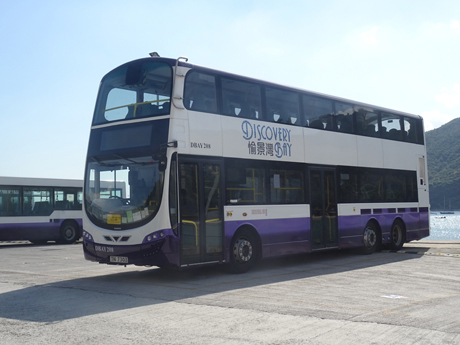
Discovery Bay Transit Services purchased six double-deck buses for use on its external route to Sunny Bay MTR Station from August 2015. It has since introduced double-deck buses to its Tung Chung route.
OTHER NON-FRANCHISED BUS SERVICES
In addition to residents' services non-franchised public buses also operate contract hire services, student services, tour services, hotel services, employee's services and international passenger services. The number of buses registered to operate in each of these categories as at the end of January 2017 is;
Contract hire service 5,516
Student service 3,190
Tour service 3,194
Hotel service 1,721
Employees service 1,754
International Passenger service 1,202
PUBLIC LIGHT BUS (GREEN AND RED MINIBUS)
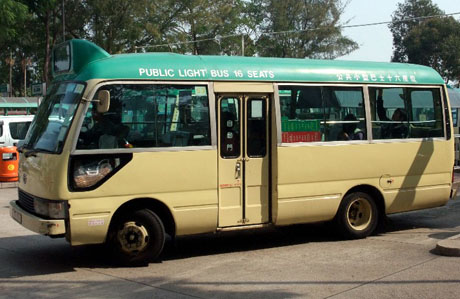
Green Minibus at Sai Kung Minibus Station. Green minibuses are regulated and operate on fixed routes with fixed fares
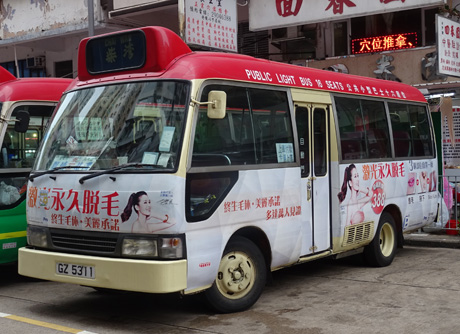
Red Minibus at Mong Lung Street, Shau Kei Wan. Red minibuses are unregulated
Almost 4,100 16, 17 and 19-seat minibuses (Public Light Bus) with a daily patronage of about 1,500,00 also provide frequent services mainly in areas where high-capacity vehicles would not be viable, although some routes do partially or wholly duplicate franchised bus routes and often provide useful “feeder services” to MTR stations and transport interchanges. Further information about Public Light Bus services are detailed under a separate section PUBLIC LIGHT BUS (Green Minibus and Red Minibus).
USING THE BUSES
Fares are paid on entry by either Octopus Card or cash and are based on a flat fare regardless of distance of travel. The Octopus Card reader and cash fare box are located next to the driver. Tickets are not issued except for “A”- prefix airport routes, where pre-paid tickets are available as an additional option to Octopus Card or cash payment. Citybus, KMB and Long Win Bus also support contactless payment by Visa, Apple Pay, Google Pay, AlipayHK and WeChat Pay HK. New Lanato Bus accepts Alipay HK contactless payment in addition to Octopus and cash. Fares are calculated in fare stages and usually reduce as each stage along the route is reached although on shorter routes the same flat fare may apply along the whole route. Octopus Card is swiped only on entry to the bus, except on a small number of routes, for example, between Central and Stanley, where sectional fares are available, in which case Octopus Card should also be swiped on exit for the card to be credited with the difference between the full fare charged on entry and the sectional fare. In February 2024 Citybus announced it was installing validators at bus stops for some routes where sectional fares are available including routes 4 and 971.

Citybus Section Fare Validator
If paying bus fares in cash (coins or notes) no change is given so the exact fare should be paid as any overpayment will not be refunded. Travel on buses is now almost cashless with the vast majority of passengers using Octopus Card for payment.
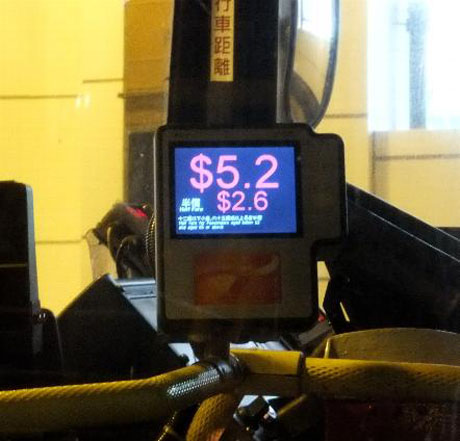
Octopus Card readers are located next to the drivers cab on buses
Standing is allowed on the lower deck only and is common on some routes during peak hours. All buses are fitted with bells for passengers to indicate they wish to disembark at the next stop and most buses (except those of New Lantao Bus Company) are fitted with visual and audible announcement systems indicating the name of the next stop in both English and Chinese. Many buses are also fitted with TV screens for entertainment and advertising. Eating, drinking and smoking on buses is not allowed.
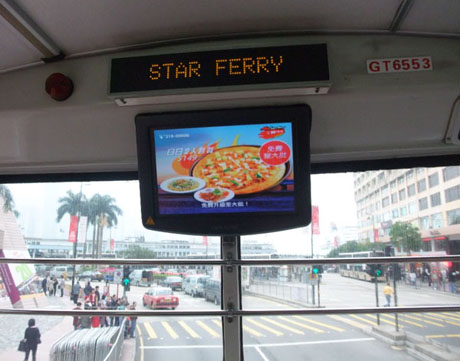
All franchised buses have display screens and audible announcement systems indicating name of next bus stop (except most buses on Lantau Island)
Since November 2008 free Wi-Fi internet access has been made available on buses on some routes operated by Citybus, including all "Cityflyer" airport routes and New World First Bus and by the end of 2014, about 300 buses were wi-fi enabled. For more information on routes with Wi-Fi access see INTERNET ACCESS.
Services to most areas are frequent and operate from early morning to around midnight. Night services also operate to many districts and the airport.
Many routes pass through the cross-harbour routes linking Hong Kong Island with Kowloon and cross-harbour route numbers are prefixed to identify which tunnel they use. Prefix "1" indicates Cross Harbour Tunnel, "6" Eastern Harbour Crossing, "9" Western Harbour Crossing. Night services to many areas which are prefixed "N", recreational services (usually special Sunday and public holiday services) prefixed "R" and shuttle (usually frequent circular) services prefixed "S". Residents' Services are prefixed "NR", "HR", "KR" or "DB" (Discovery Bay) although some "NR" services are often referred to under the old numbering system which instead carried a suffix of "R"
JOURNEY PLANNING
Full details of routes, frequencies and fares can be obtained by using search engines on the bus operators websites for which links are provided under the "Current Franchised Bus Operators" section above. Users of mobile devices can download KMB and Citybus/NWFB apps with route planning and fare information.
All bus companies have websites (links can be found in information above for current franchised bus operators) which have details of routes, fares and timetables. The websites and apps of KMB/Long Win and Citybus/New World First Bus also have interactive point to point journey planners.
KMB was, in March 2011, the first bus company in Hong Kong to launch an iPhone app providing comprehensive information on KMB and its sister company Long Win Bus Company's services. The app offers four functions, “Point to Point Search”, “Route Number Search”, “Nearby Bus Stop” and “Alight Reminder”. The first three functions provide users with different ways to search for a bus route, offering detailed routings, route maps, timetables and route announcements, as well as photos of every bus stop. In the “Point to Point Search”, when several routes serve the same destination the system displays the lowest fare option as well as the route with the fewest en-route stops, allowing users to make their own choice according to their needs. The “Nearby Bus Stop” function, making use of the iPhone’s Global Positioning System, automatically identifies the location of the user and list all bus routes available and the location of their corresponding bus-stops within 200 metres. The KMB iPhone App is available in traditional Chinese, simplified Chinese and an English version. The English version can be selected from the iPhone settings menu. iPhone and iPod Touch users can download the App free of charge from the iTunes App Store. The app has since been made available on other mobile platforms. In October 2011 Citybus and New World First Bus launched a similar App for iPhone and Android devices.
The operators websites and apps only provide information for their own services and jointly operated services. The government’s Transport Department, however has launched its “HKeTransport” website and mobile apps which enable journey planning by all modes of public transport by all operators;
http://hketransport.gov.hk/?l=1
Additionally, Hong Kong eTransport Kiosks have been installed at several locations, including the Arrival Hall of Hong Kong International Airport, Hong Kong Convention and Exhibition Centre, Tsim Sha Tsui Star Ferry Pier, MTR Sha Tin Station and Tuen Mun Road Bus-Bus Interchange, for use of tourists and other members of the public who may not be able to readily access the internet.
Universal Publications publishes a bilingual "Public Transport Guide" (HK$68, first published November 2019) containing comprehensive street and area maps with names in English and Chinese showing franchises bus and green minibus routes by number and boarding points for the busiest areas of Hong Kong. The guide can be obtained certain booksellers in Hong Kong including Commercial Press, Bookazine and Li Tung Book and Stationery Co or can be ordered from the publishers website. The guide replaces the previous "Public Transport Atlas" which was more comprehensive but is no longer published.
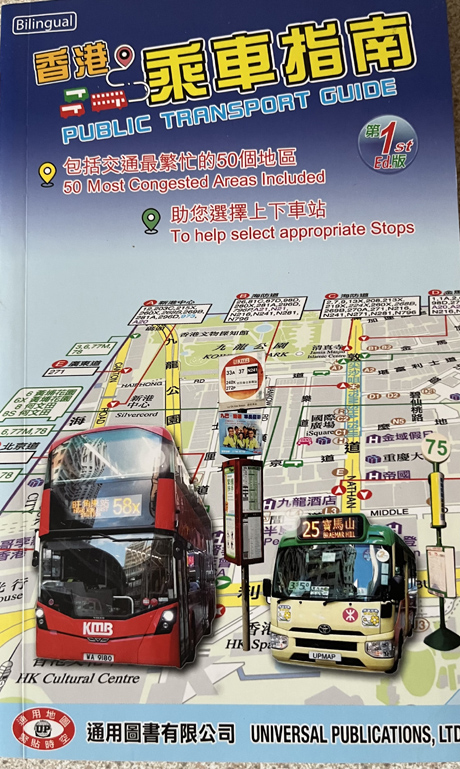
Universal Publications "Public Transport Guide" contains maps showing bus and green minibus stops in the busiest areas as well as comprehensive information regarding other public transport
Citybus/New World First Bus publish a free leaflet "Hong Kong Bus Travel Guide" in English detailing airport routes and hotels served and several scenic routes. This can be obtained from Citybus/New World First Bus Customer Service Kiosks at the Airport bus terminus and Admiralty (East) bus station or downloaded from the Citybus/NWFB website.
RECENT DEVELOPMENTS
Since 2001 all franchised bus companies, except New Lantao Bus Company, have agreed that all new buses will be wheelchair accessible and at the end of March 2013 there were 3855 wheelchair accessible low-floor buses. All franchised buses are expected to be low-floor by 2017 with the exception of some buses operated by New Lantao Bus Company along routes on Lantau Island which have topographical constraints such as steep gradients and sharp bends which are unsuitable for wheelchair accessible buses.
Double-deck buses were first introduced into Hong Kong in 1949 and most of the current fleet are 12-metres length but on some difficult routes shorter double-deckers of 10 or 11-metre length are used. In recent years the fleet has been upgraded to meet European emission standards. Kowloon Motor Bus (KMB) with a fleet of 3725 has retired all 288 of its Euro 1 buses and replaced with Euro IV and V models. New World First Bus and sister company Citybus had replaced all their 440 pre-Euro and Euro I buses by the end of 2012. In December 2012, KMB ordered 370 brand new E500 Euro V air conditioned double-deck buses from British manufacturer Alexander Dennis Limited. The buses, which KMB co-developed with the manufacturer, are expected to produce fuel savings and a reduction of 10% in carbon emissions by reducing body weight and utilising a more efficient air conditioning system and its chassis will be compatible with the future Euro V1 engine. Passenger capacity of the new buses is 136 (90 seated and 46 standing). The order is part of KMB's 5-year purchasing plan which will see 1800 older buses replaced and the new buses, which were in service by mid-2013, are used on routes connecting urban areas with new towns in the New Territories.
The number of buses and routes has declined slightly since 2003 under the Transport Department's Bus Service Rationalisation Plan to enhance the efficiency of the bus network by avoiding unnecessary overlapping of routes and reducing frequencies to take into account passengers increased choice of transport with the opening of new railway lines as well as reducing congestion and pollution. Part of the route rationalisation process is the introduction of Bus-Bus Interchange hubs (BBI's), the first of which was Tuen Mun Road Bus-Bus Interchange which opened in December 2012.
All buses are air-conditioned, since KMB phased out its few remaining air-conditioned buses in May 2012. Double-deck buses were first introduced into Hong Kong in 1949 and most of the current fleet are 12-metres length but on some difficult routes shorter double-deckers of 10 or 11-metre length are used. In recent years the fleet has been upgraded to meet European emission standards. Kowloon Motor Bus (KMB) with a fleet of 3725 has retired all 288 of its Euro 1 buses and replaced with Euro IV and V models. New World First Bus and sister company Citybus had replaced all their 440 pre-Euro and Euro I buses by the end of 2012. In December 2012, KMB ordered 370 brand new E500 Euro V air conditioned double-deck buses from British manufacturer Alexander Dennis Limited. The buses, which KMB co-developed with the manufacturer, are expected to produce fuel savings and a reduction of 10% in carbon emissions by reducing body weight and utilising a more efficient air conditioning system and its chassis will be compatible with the future Euro V1 engine. Passenger capacity of the new buses is 136 (90 seated and 46 standing). The order is part of KMB's 5-year purchasing plan which will see 1800 older buses replaced and the new buses, which were in service by mid-2013, are used on routes connecting urban areas with new towns in the New Territories.
In order to increase non-fare box revenue bus operators have equipped many bus shelters with electricity supply to display illuminated advertisements and provide power for vending machines. 1,477 bus shelters had been provided with electricity supply by the end of 2014 and 28 vending machines had been installed.
During March 2012 KMB submitted proposals to the Transport Department to operate an electric bus route in east Kowloon. New circular route 5M would operate between Ping Shek Bus Terminus and Eastern Road at Kai Tak using single-deck buses developed by Youngman, a coach maker in Zhejiang province, in co-operation with German bus manufacturer Neoplan. The buses have a range of up to 10 kilometres after being fully charged and can maintain a continuous supply of air conditioning for up to an hour. There would be two charging stations at bus stops, using super-capacitor technology, which allow the zero-emission bus to get electricity from hanging wires through a pantograph extended from its roof. It had been expected, subject to approval, that the service would commence operating from mid-2013 but no further developments appear to have materialised. The range more than doubles the design range of the gBus, made by a joint venture of Volvo and Shanghai Automotive Industry Corporation, which was tested in 2011 and was found to have an actual range of only about 3.5 kilometres with the air conditioning running. KMB is also proposing to invest about HK$300 million on an electric bus network at Kai Tak before the completion of a HK$12 billion monorail in 2023 in the Kowloon East redevelopment project. In September 2012 KMB took delivery of its first fully battery-powered single-decker, known as the eBus, jointly developed by KMB and mainland manufacturer BYD. Based at Lai Chi Kok Depot, the gold-painted eBus is expected to be tested in areas of high roadside pollution such as Nathan Road. A rival electric bus manufacturer, Great Dragon, confirmed it was supplying a right-hand drive bus to a Hong Kong utility company in October 2012 for trials. A government-funded trial of electric buses began in 2013 and approval has been given for procurement of 36 buses and charging facilities to be trialled by KMB, Citybus/New World First Bus, Long Win Bus and New Lantao Bus. . Since 2010 KMB has also been conducting trials of an electric "gBus" (green and genesis) with zero emissions, leased from a Shanghai company. The single-deck bus which is 12 metres long and can carry up to 70 passengers operates on a super-capacitor system which allows the bus to travel 1km on a 30-second charge. Although trials operated satisfactorily, KMB is testing other prototypes with a longer range as well as testing battery-driven buses and hybrids. BYD, backed by US investment guru Warren Buffet, and Great Dragon - a joint venture between mainland bus maker Yixing and Global Electric Vehicles, owned by Hong Kong-listed Dah Chong Hong announced is piloting a new breed of electric bus at its Changsha factory, designed with Hong Kong road conditions in mind. It is building 16 single-decker electric buses for testing in Hong Kong by organisations awarded subsidies under the government's Green Transport Fund and in November 2013 KMB began a one-month trial of a BYD electric single-decker on route 2, which plies between Star Ferry Pier at Tsim Sha Tsui and So Uk, a distance of 7km. The bus is charged each night at Lai Chi Kok depot and three hours charging is sufficient for 180km travel. The bus can accommodate 66 passengers (31 seated and 35 standing).
In March 2013 Citybus announced that it was replacing the whole of its 15/16 year old "Cityflyer" airport bus fleet over a two-year period commencing April 2013. 66 new Alexander Dennis Enviro500 Euro5 buses feature reclining high-back leather seats, individual reading lights above upper deck seats and larger luggage racks as well as enhanced environmental performance. Multi-functional LCD panels display the names of the next three bus stops and hotel names, all buses are equipped with free wi-fi and luggage rack areas are monitored by CCTV. The fleet has been replaced two years ahead of the normal fleet replacement schedule.
In June 2014 the Transport Department approved a fare increase averaging 3.9% on KMB services with effect from 6th July 2014 after over 70% of KMB's routes were loss making.
The longest buses in Asia began operating in Hong Kong in June 2014 when KMB began testing protoypes of two models of 12.8 metre double deck buses with a passenger capacity of 146, 8 more than any bus in the existing fleet. The buses can cater for 98 seated passengers (35 on the lower deck, 63 on the upper deck) as well as 48 standing passengers. The models are Alexander Dennis Enviro500 Turbo and Volvo B9TL. Components were made in the UK and assembled in Zhuhai. KMB placed orders for four prototypes, two from each manufacturer, each costing over HK$3 million. Testing was expected to last for about three months with the buses operating on four routes with heavy demand in the New Territories, 43X and 49X Sha Tin to Tsuen Wan, 277X Fanling to Lam Tin and 279X Fanling to Tsing Yi.
New World First Bus and Citybus took delivery of three Government subsidised 12-metre Enviro 500 Hybrid Double Decker buses from UK manufacturer Alexander Dennis in mid-September 2014.The buses are equipped with a small diesel engine which powers the on board generator which provides electricity for the drive motor, air conditioning and other facilities and charges the internal Lithium Ion-batteries. The latest intelligent "Arrive and Go" technology allows the bus to shut the diesel engine down when approaching a bus stop at speeds of less than 6.4km per hour and switch to electrical mode. The diesel engine restarts when the speed rises above 11.2km per hour. Following their introduction into service the buses are subject to comprehensive testing by the companies and the Environmental Protection Department for performance, fuel performance and emission efficiency.
In November 2014 KMB introduced Hong Kong's first Euro VI Hybrid Double-Deck hBuses for a 24-month trial of passenger services on three routes, 1A Star Ferry - Sau Mau Ping, 619 Shun Lee - Macau Ferry (Central) and 104 Pak Tin - Kennedy Town. The hybrid buses are the first double-deck buses equipped with a Euro VI engines, and the first double-deck buses with the air-conditioning system powered by electricity. It is expected that hBus will achieve fuel savings of up to 30%, while emissions of major pollutants will be reduced considerably (e.g. particulate matter by 50% and NOx by 80%), when compared to Euro V double-deck buses. hBus is equipped with a “hybrid series” driveline system and a generator driven by a diesel engine that supplies electricity to drive an electric motor which powers the axles. The regenerative braking system captures the otherwise wasted braking energy and stores it in the batteries, making the bus even more environmentally efficient.
In early 2016 it was disclosed by the Environmental Health Department that the hybrid double-deckers have not been as efficient as expected owing to heavy use of air conditioning systems during the summer which has led to overall higher fuel consumption than conventional buses.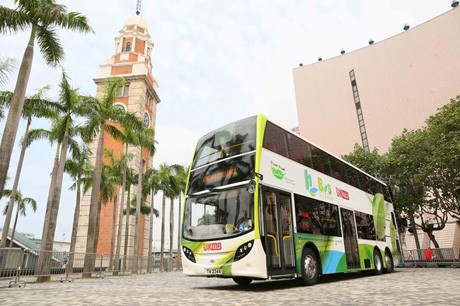
Hong Kong's first Euro VI Hybrid hBus was introduced into service in November 2014 by KMB
Under the 2015/2016 Bus Route Development Programme the Transport Department and bus operators are proposing to enhance services of the bus network serving the airport. It is planned to introduce two new Long Win Airbus "A" routes serving Yuen Long and Tai Po as well as a new supplementary service to route A33. In addition it is proposed to increase the service frequency or operating hours of four "E" external airport routes and the S56 circular route between the airport and Tung Chung Station.
In July 2015 New World First Bus and Citybus took delivery of the first of five government funded BYD zero-emission battery powered model K9R single-deck buses. The 11.6 metre buses have a range of 250km after a full four hour charge and can carry 31 seated and 35 standing passengers. Following a period of testing the first of these buses entered service on 27th December 2015 for a two year trial on Citybus route 11 (Central Ferry Piers to Jardine's Lookout Circular) with the other four buses following on 28th December 2015 on Citybus route 12 (Central Ferry Piers to Robinson Road Circular) and New World First Bus route 81 (Lai Tak Tsuen to Chai Wan Circular), 29th December 2015 on Citybus route 25A (Hong Kong Convention and Exhibition Centre Extension to Braemar Hill Circular) and 5th January 2016 (tentative) on New World First Bus route 78 (Wong Chuk Hang to Wah Kwai Estate Circular). Later in 2016 a five further battery operated buses are expected to enter trial service on Citybus/New World First Bus routes and 26 battery operated buses will begin trials on other operators routes. To monitor the trial of electric buses, the Government is setting up a task force, comprising representatives from franchised bus companies, the Environmental Protection Department and the Transport Department, and local experts. If the trial results are satisfactory, the Government will encourage franchised bus companies to use electric buses on a larger scale, taking into account affordability for the franchised bus companies and passengers. These buses were taken out of service on 8th December 2015 after it was found that the bus could open if the door seal was strongly pressed from the inside. Following inspection by the bus manufacturer and implementation of a control software upgrade the buses returned to service on 11th January 2016. NWFB and Citybus planned to introduce its second batch of five Government-funded battery operated buses into service on routes 11 (Central Piers - Jardine's Lookout),12 (Central Piers to Robinson Road),25A (HKCEC - Braemar Hill), 78 (Wong Chuk Hang to Wah Kwai Estate) and 81 (Lai Tak Tsuen to Chai Wan) on 12th September 2016. However, their introduction has been deferred as a result of a problem with the door bell alarm which is awaiting rectification by the manufacturer. The buses have a passenger capacity of 35 seated and 29 standing and performance of the vehicles will be assessed over a two year period. Further problems occurred in mid-September when the first batch of five BYD buses, operating on routes 11, 12, 25A, 78 and 81, was taken out of service owing to problems with tyre slippage in wet weather. The braking system has since been improved by the manufacturers but the buses will not return to service until thorough checks have been carried out.
The first locally designed electric bus had been due to begin operating one month of test runs on Hong Kong's roads in November 2015. The 12.5 tonne single-deck bus was designed by Hong Kong Productivity Council and Hong Kong Automotive Parts and Accessory System's Research and Development Centre in partnership with Green Dynamic Electric Vehicle Limited. The bus was built in mainland China and underwent nine months of trials in Chongqing and Dongguan before being delivered to Hong Kong. The 11.75-metre vehicle has a passenger capacity of 75 (35 seated and 40 standing) and can travel at up to 70km/ph. A four hour battery charge enabled the bus to travel up to 380km. The body was made of lightweight aluminium alloy, weighing 10 per cent less than existing electric buses, and has a gear-free permanent magnet synchronous motor and lithium polymer battery. The HK$40 million project began in August 2013 and was funded by the government's Innovation and Technology Fund. However, the prototype bus was destroyed by fire resulting from a short circuit and overheated battery on 13th December 2015. The cause of the fire was seepage of water into battery casings which led to short-circuiting and it is believed the battery casings had been damaged during performance tuning and inspection by Green's technical support staff in Dongguan.
In August 2017 Citybus and New World First Bus submitted applications to the government for fare increases averaging 12% which would see fares for most Hong Kong Island routes increase by about HK$1 per trip and cross-harbour routes by about HK$2 per trip. Both operators have not increased fares since 2008 and have suffered a decline in patronage since the opening of the MTR Island Line extension to Kennedy Town in 2015 and the South Island Line in 2016 in addition to incurring substantial fleet replacement costs and a decline in advertising revenue. If approved, the increases would be expected to be implemented in January 2018.
In September 2017 KMB began trials of a solar powered air conditioning system on one of its double-deck buses. 20 solar panels have been installed on the roof of the bus which provide a supplementary power source for the air conditioning system and can also supply power to on board USB ports. The trial bus is operating on Tuen Mun routes and KMB is planning to gradually add panels to other double-deck buses in its fleet.
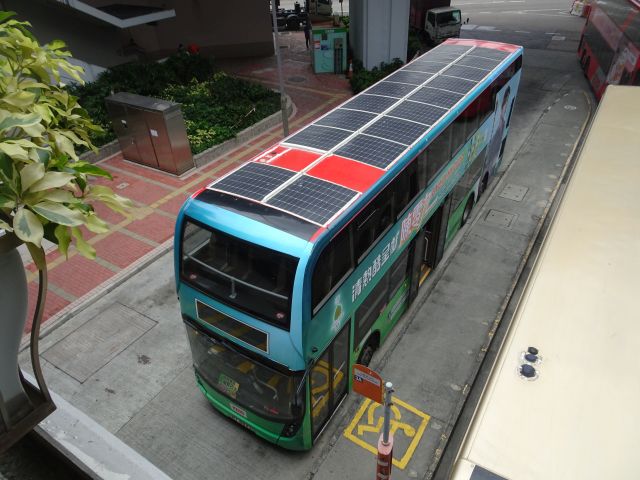
KMB bus fitted with solar panels on route 3A at Rumsey Street, Central, December 2023
Following a fatal accident in February 2018 involving a double-decker bus, a Working Group comprising members of all franchised bus operators and major bus manufacturers was set up to further enhance bus safety. Following the Working Group's recommendations all new double-decker buses procured by franchised bus operators from July 2018 will have an Electronic Stability Control System and Speed Limiting Retarders and all passengers seats in all new buses ordered from July 2018 will have seat belts fitted.
KMB announced in early 2019 that it is to internally refurbish its "mid-life" (about 8 years old) buses with paint respray, new seats and a fresh new look to bring to enhance the comfort level of the buses to the same standard as the new generation "Red Bus". The project is expected to begin in June 2019 with about 270 buses being refurbished in the first batch.
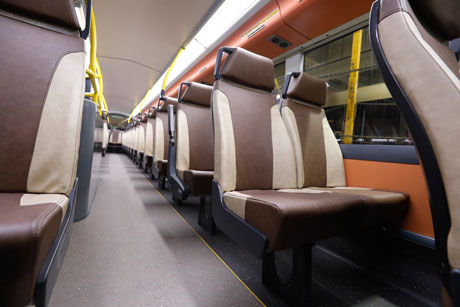
KMB's "mid-life" bus refurbishment programme will see bus interiors achieve comfort standards in line with the new generation "Red Bus" fleet
In January 2019 the government approved fare increases averaging 7% and 5.5% for routes operated by Citybus (franchise for Hong Kong Island and Cross-Harbour Network) and NWFB respectively. The revised fares take effect on 20th January 2019. These are the first fare increases since 2008 and have been mitigated by the governments Franchised Bus Toll Exemption Funds which were introduced in the Chief Executive's 2018 Policy Address. Had it not been for the exemption the fare increases would have amounted to 9%.
In August 2019 NWFB &Citybus announced a trial involving linking its Automatic Bus Stop Announcement System to the Octopus Fare Payment System to automatically adjust section fares and route direction without manual input to eliminate human error in making system adjustments. Routes 8H, 11, 12, 12A, 12M, 13 and 511 have been selected for the trial with the intention of phasing in the function to all routes before the end of 2019.
In June 2020 New World First Bus and Citybus took delivery of their first solar powered double-decker bus. The vehicle is an Alexander Dennis Enviro 500 MMC 12m which will carry fleet number 5588 and will operate on NWFB route 8 between Heng Fa Chuen and Wan Chai (North). NWFB and Citybus will monitor its environmental performance to further study the feasibility of extending the solar power system to more buses and expanding its use for more electrical devices in the bus compartment.
In January 2021 NWFB and Citybus commenced the phasing in of a QR code e-payment system on its fleet of buses. Accepted transit QR codes are AlipayHK "EasyGo", Alipay "Transit QR Code" and UnionPay "Transit QR Code". The first routes to be included in the scheme from 9th January 2021 are Citybus A29/A29P, E21A, 20/20A and NWFB routes 23, 694, 796C and 798. During 2021 the QR payment will be extended to all NWFB and Citybus routes and a contactless credit card payment system will also be introduced.
In March 2021 franchised bus operators were granted approval for fare increases as follows;
CITYBUS (FRANCHISE 1) AND NEW WORLD FIRST BUS ( Hong Kong Island and Cross-Harbour Routes) - overall 12% increase to be implemented in two phases, 8.5% effective from 4th April 2021 and 3.5% from 2nd January 2022.
NEW LANTAO BUS COMPANY (1973) LIMITED - overall weighted increase of 9.8% effective from 4th April 2021. Fares for the three Ngong Ping routes will increase by about 15% on Sundays and public holidays and those of boundary routes and recreation and special services by about 10%. The average increase for routes serving Tung Chung and for South Lantau routes on weekdays will be between 8.2% and 9.7%.
KOWLOON MOTOR BUS - overall 8.5% increase to be implemented in two phases. 5.8% effective from 4th April 2021 for solely operated KMB routes. 8.5% effective from 4th April 2021 and 3.5% from 2nd January 2022 for cross-harbour routes jointly operated with Citybus and New World First Bus.
Citybus did not apply for a fare increase in respect of its Franchise 2 (Airport and North Lantau routes) and Long Win Bus Company's application for a fare increase was rejected therefore fares on these routes will remain unchanged.
The bus operators submitted the fare increase applications to the Government in 2018 and 2019 but the processing of the fare increase applications was put on hold amid the uncertainties arising from the COVID-19 pandemic. In view of the impact of the pandemic on the franchised bus operators, the Government has introduced several rounds of relief measures under the Anti-epidemic Fund, including fuel and other one-off subsidies and the Employment Support Scheme, to help franchised bus operators cope with the operating pressure in the prevailing economic environment. With the gradual cessation of these relief measures by the end of 2020, individual franchised bus operators have been facing severe financial difficulties.
In March 2021 Hong Kong's first air-conditioned indoor bus terminal opened at Yue Man Square in Kwun Tong. The two-storey terminus is part of the Urban Renewal Authority's Yuen Man Square redevelopment project with the franchised bus terminus integrated with the shopping on the upper level and the minibus terminus on the lower level. Passengers will remain inside the mall behind automated gates until buses arrive. 8 franchised bus routes, 12 green and 9 red minibus routes will serve the new terminus. 3 spaces in the terminus are allocated for fast-charging of electric minibuses.
In June 2021 KMB announced it has invited tenders from manufacturers around the world for 42 all-electric buses to operate between new development areas and city towns and expected to commence service in the second half of 2022. The company's aim is to increase its fleet of electric buses to 500 in five years and convert all its 4,000 diesel buses into electric buses by 2050.
In June 2021 the Transport Advisory Committee indicated that following an independent consultancy exercise which indicated general satisfaction with services, it would commence discussions with Long Win, NWFB and Citybus (Franchise 2 - Airport & North Lantau routes) regarding awarding of new 10-year franchises when the current franchises expire in 2023.
Since October 2021 (NWFB / Citybus) and February 2022 (KMB / Long Win) operators have made contactless credit card and mobile payment available on all bus routes. Payment methods include Visa, Mastercard and Union Pay contactless card and Apple Pay, Google Pay and Samsung Pay and Union Pay mobile payment.
KMB introduced 16 new electric buses in April 2022 serving route 6 connecting the urban area, including Nathan Road and Kwun Tong Road. The new BYD B12A single-deck electric buses are 4% lighter than the old model K9R electric bus, with the passenger capacity increased by 16% to 81. The vehicles take only one hour and 40 minutes to be fully charged - 2 hours faster than before - to deliver 200 km of zero-emission journeys. The bus body is painted "Electric Green," and the buses are equipped with a battery management system and a water-cooling system. The new bus is a collaboration between KMB and CLP Power, where CLP Power provides technical support for charging systems, and KMB shares related data that lays the foundation for electrifying KMB's bus fleet. KMB has also purchased 52 double-deck electric buses expected to be delivered in early 2023 with 42 being supplied by BYD and 10 by Alexander Dennis and will also purchase a further 500 electric buses in 2025. In July 2023 the first bus in a batch of 52 BYD electric double-deckers was to begin service on route 213M between On Tai and Lam Tin MTR Station. The 115 passenger capacity buses have a range of 300km with a charging time of 2 hours and will be charged overnight at KMB's Kowloon Bay depot. The remaining buses in the batch are expected to enter service before the end of 2023. KMB, which in addition to Kowloon Bay has existing charging facilities at Sha Tin and Lai Chi Kok is to invest HK$2 billion in new multi-storey charging and parking depots at Tai Po and Tuen Mun which will have capacity for 850 buses.
In April 2022 Bravo Transport, the parent company of Citybus and New World First Bus announced its intention to replace its entire fleet of 1,700 buses with zero-emission buses by 2045. The fleet will include battery-powered double-deckers with a passenger capacity of 143 and specially designed in collaboration with Wisdom (Fujian) Motor Company to navigate Hong Kong's hilly terrain. Hong Kong's first all-electric double-deck bus officially commenced service on 19th June 2022 on Citybus route 5B from Hong Kong Stadium to Kennedy Town until 2nd July following which it will operate in Kowloon on Citybus routes 20, 20A and 22M from 4th July 2022 for a trial period.
In mid-2022 franchised operators KMB, Long Win, Citybus and New World First Bus submitted applications for fare increases of up to 20% owing to increased costs such as fuel and declining passenger numbers. The applications are under consideration by the transport authorities and includes consulting the Legislative Council before the request is put to the Executive Council for a final decision.
In October 2022 KMB launched a trial of a "pay before boarding" system whereby passengers can pay their fare by Octopus Card or other electronic means before queuing and boarding the bus. The trail took place at Tuen Mun Road Passenger Transport Interchange in respect of route 263 at a designated payment area between the hours of 7am and 9am daily. Initial results indicated that a total reduction in boarding time of 76 minutes was achieved during these peak hours for the 380 buses passing through the interchange.
In February 2023 in the Budget Speech the government announced a target of introducing about 700 electric buses by the end of 2027. HK$200 million will be allocated from the New Energy Transport Fund for progressively commencing trials of hydrogen fuel cell electric double-deck buses and heavy vehicles during 2023 in collaboration with franchised bus companies and other stakeholders to fully assess their operational feasibility under local circumstances. Hong Kong's first hydrogen refueling station is expected to be installed at Citybus' West Kowloon depot in August 2023 with the first hydrogen fuelled buses in service by October 2023. Citybus expects to have five hydrogen buses, each with a range of about 400km, in service within a year. Equipment for the fuelling station is being manufactured by CIMC Enric’s CIMC Hydrogen (Beijing) Energy Technology Langfang Manufacture Base. A second much larger hydrogen refuelling station is planned for one of Citybus' Hong Kong Island depots.
In March 2023 all five franchised bus operators applied for fare increases ranging from 8.5% to 50% citing substantial losses, increased operating costs and falling patronage. Citybus applied for a 50% rise in fares on its airport "A" and "NA" routes which have not increased in 25 years and 23% on its other airport routes. Citybus and NWFB applied for a flat HK$2 rise on HK Island and cross-harbour routes. KMB applied for a 9.5% increase whilst its Long Win subsidiary applied for an 8.5% increase. New Lantao Bus has applied for a 9.8% rise. Following consideration by the government the following increases were aproved to take effect from 18th June 2023;
LONG WIN BUS COMPANY LIMITED - increase by an overall actual weighted average rate* of 4.2%.
CITYBUS LIMITED - (Franchise for the Airport and North Lantau bus network) - increase by an overall actual weighted average rate* of 4.2%.
CITYBUS LIMITED (Franchise for Hong Kong Island and Cross-Harbour bus network) and NEW WORLD FIRST BUS SERVICES LIMITED - increase by an overall actual weighted average rate* of 4.9%.
NEW LANTAO BUS COMPANY (1973) LIMITED - increase by an
overall weighted average rate* of 7.0%;
KOWLOON MOTOR BUS COMPANY (1933)
LIMITED - increase by an overall actual weighted average rate* of 3.9 %
* actual weighted average rate takes into account (where
applicable) the mitigation effect of the Franchised Bus Toll Exemption Fund
Upon the implementation of new fares about 87% of passengers are expected to
pay no more than 50 cents extra per trip and almost all passengers are expected
to pay no more than HK$1 extra per trip.
Summary of the bus operators applications and the government decision is available at the link below;
https://gia.info.gov.hk/general/202305/30/P2023053000399_420640_1_1685431761698.pdf
In considering and reviewing the applications, the Government noted that the franchised bus operators submitted their applications last year against the backdrop of the fifth wave of the epidemic and oil prices also at a higher level. Accordingly, the Government has suitably adopted projections with a relatively positive recovery outlook with the benefit of the most up-to-date patronage figures reflecting the prevailing normalcy and cross-boundary travel situation. The Government has also taken into account the future opportunities of business growth for the franchised bus operators arising from the new population intake of major new developments such as those in Hung Shui Kiu/Ha Tsuen, Anderson Road in Kwun Tong, and Tuen Mun Area 54.
The Government has been implementing the non-means tested
Public Transport Fare Subsidy Scheme (PTFSS) since 2019 to relieve the fare
burden of passengers who travel on local public transport services for daily
commuting and whose public transport expenses are relatively high. For the
beneficiaries of the PTFSS, a portion of the increase in bus fares could be
subsidised by the PTFSS.
According to the Fare Adjustment Arrangement for Franchised Buses the
Government has taken into account a basket of factors in assessing the bus fare
adjustments:
(a) changes in operating costs and revenue since the last fare
adjustment;
(b) forecasts of future costs, revenue and return;
(c) the need to provide the bus operator with a reasonable rate of
return;
(d) public acceptability and affordability;
(e) the quality and quantity of service provided; and
(f) the outcome of the supportable fare adjustment rate formula.
The formula is only for reference and will not operate as an automatic
determinant of the rate of fare adjustment.
In August 2023 KMB, in conjunction with 5G network provider SmarTone began a trial of a real-time upper deck seat vacant seat capacity counting system. Cameras will monitor the number of people entering and leaving the bus and the number of vacant seats remaining on the upper deck will be displayed on a lower deck screen near the stairwell.
MTR took delivery of its first electric bus in November 2023 with the vehicle expected to be in service in the first quarter of 2024 following a series of tests and approvals.
As at September 2023 Hong Kong had a total of 59 registered electric franchised buses
From 3rd February 2024 KMB new route 230R, operating on weekends and public holidays between Kowloon Station and Ma Wan, became the first route to be operated entirely by double-deck electric buses. Also in February 2024 KMB announced it had purchased ten electric double-deck buses from British manufacturer Alexander Dennis expected to enter service in the first half of 2024 subject to Transport Dept approval. KMB already has 82 electric buses in service from Chinese manufacturer BYD including 42 double-deckers.
Hong Kong's first hydrogen double-decker bus, purchased by Citybus, received approval in November 2023 and had successfully completed 200km of testing at the company's West Kowloon Depot by February 2024 following which road testing without passengers was undertaken before the bus entered service on 25th February 2024 operating between Kai Tak and Cheung Sha Wan on route 20. The bus will also operate on routes 20A and 20M in the next phase of its introduction. The bus was scheduled to make its first cross-harbour journey on 14th July 2024 on route 170 Wah Fu - Sha Tin Station. The bus which has a passenger capacity of 119 takes 15 minutes to refuel for a range of 400km. Hydrogen buses were originally not permitted to operate through tunnels and the bus operates in the Kai Tak area of Kowloon. However, in March 2024 the Inter-departmental Working Group on Using Hydrogen as a Fuel granted permission for hydrogen vehicles to use Hong Kong's extensive network of tunnels. Citybus plans to introduce a further five hydrogen buses into service in 2025 based at its Chong Fu Depot on Hong Kong Island and intends for its entire fleet to be hydrogen powered by 2045.
In June 2024 MTR introduced its first electric bus into service on route K54 connecting Wo Tin Estate, Siu Hong Station and Tuen Mun Town Centre. MTR plans to gradually replace its existing fleet of diesel buses and expects to have 30 electric buses in service by the end of 2026.
In December 2024 the Government announced its Green Transformation Roadmap of Public Buses and Taxis which will provide subsidies to franchised bus operators to purchase 300 e-buses. The subsidy will amount to HK$400,000 for single-deck buses and HK$800,000, or 25% of the capital cost, whichever is lower.
Fare increase January 2025 - Following applications dating back to early 2024 from franchised bus operators for fare increases, after consideration by the Government and Transport Advisory Committee the following increases were approved to take effect from 5th January 2025;
Kowloon Motor Bus (KMB) 4.3% (application was for 6.5%)
Citybus (Urban & New Territories routes) 7.5% (application was for 9.5%)
New Lantao Bus (NLB) 6.5% (application was for 6.5%)
In approving the increases consideration was given to mitigation effect of the Franchised Bus Toll Exemption Fund (TEF), operating situation of the franchised bus industry, forecast financial performance, indices relevant to public affordability, as well as quality and quantity of their bus services. Fares were last increased from 18th June 2023. Citybus Airport and North Lantau franchise and Long Win Bus (LWB) franchise were not part of the fare increase applications and fares on routes served under those franchises remain unchanged.